Git 2.56.1 Security Release: Six Vulnerabilities Fixed
The Git project released Git 2.56.1 on November 10, 2026, fixing six security vulnerabilities. The fixes also landed as backports in 2.55.1, 2.54.1, 2.53.1, 2.52.1, 2.51.3 and 2.50.2. The most serious flaw, CVE-2026-111760, lets a crafted repository run attacker code during a recursive clone.
None of the six flaws needs an exotic workflow to trigger. They sit in clone, merge, patch apply and fast-import, which are the operations developers and automation run on other people's repositories every day. That placement is the real story of this release: the attack surface is not a rarely used Git feature, it is the default way code moves between machines.
The Six Fixes in Git 2.56.1
| CVE | Triggering operation | Effect |
|---|---|---|
| CVE-2026-111760 | Recursive clone | Code execution through a submodule .git symlink |
| CVE-2026-113408 | Clone of an empty repository over protocol v2 | Path traversal through an unvalidated HEAD symref |
| CVE-2026-114467 | Merging a signed tag | Stack corruption when a tag carries more than two signatures |
| CVE-2026-114469 | Binary patch apply | Out-of-bounds read when a small patch expands past the size check |
| CVE-2026-105437 | Large merges | Heap corruption from a result size overflow |
| CVE-2026-114466 | fast-import streams | Arbitrary file read and write through stream features |
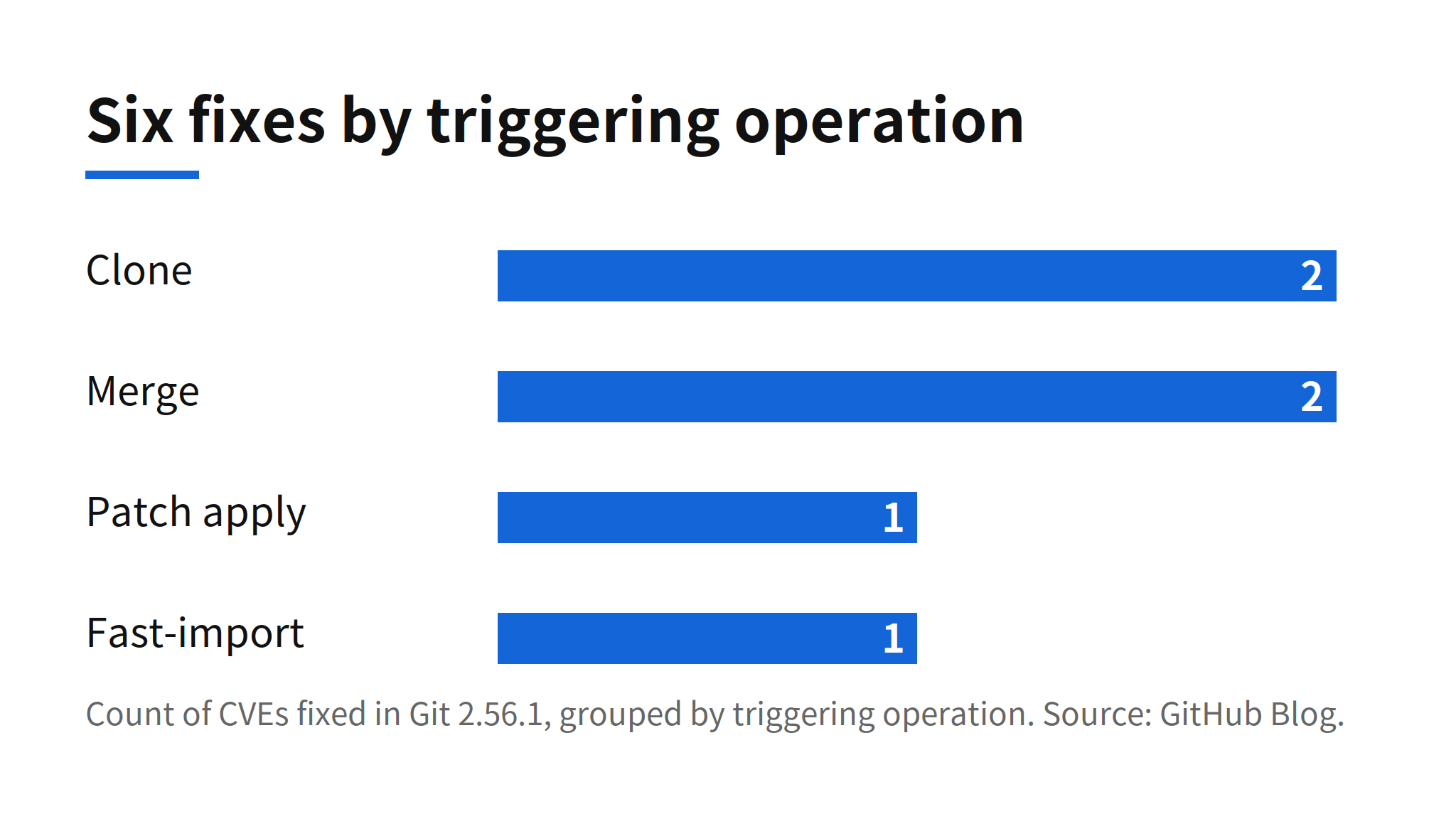
Two of the six are clone bugs and two are merge bugs. Clone and merge are also the two operations that coding agents and CI systems perform most often on repositories they did not write. A vulnerability set concentrated there matters more than the raw count of six suggests, because the exposure scales with how much unattended fetching a team's tooling does.
Recursive Clone Code Execution in Detail
CVE-2026-111760 starts with integer truncation in Git's index handling. A very long path can pass a name check under its long form and then be recorded under a shorter name. An attacker can use that gap to replace a submodule's .git file with a symlink pointing at a directory that holds malicious configuration or hooks. When Git later uses that directory, the attacker's code runs.
The chain is worth reading slowly, because each step looks harmless on its own. A path length mismatch becomes a file substitution, the file substitution becomes a configuration redirect, and the configuration redirect becomes code execution through hooks. Recursive clone is the delivery vehicle: submodules are exactly where a user is least likely to inspect what a repository contains before Git processes it.
The Remaining Five Flaws
CVE-2026-113408 is a path traversal in protocol v2 clones of empty repositories. If a server advertises a HEAD symref pointing at a branch with no commits yet, Git stored the target without validating it. With the files reference backend, that could later write files outside the reference directory.
CVE-2026-114467 sits in signature stripping code that assumed at most two GPG signatures. Merging a tag that carries more than two signatures could write past a fixed size stack array, corrupting memory and causing a denial of service. CVE-2026-114469 is an out-of-bounds read in binary patch apply: the size check looked only at the supplied size, so a small compressed patch could expand past the roughly 1 GiB limit and bypass it. The fix now checks the declared uncompressed size as well.
CVE-2026-105437 is a heap corruption in large merges, where the result size calculation can overflow when a merge has many conflicts and a large conflict-marker-size, leading Git to allocate a smaller buffer than the result needs. GitHub notes that applications and hosting services merging untrusted content are affected too, not only interactive users. CVE-2026-114466 closes a fast-import hole: the rewrite-submodules-from and rewrite-submodules-to stream features could read arbitrary files, and export-pack-edges could create or append to files. In input streams, these features now require an explicit --allow-unsafe-features flag.
Fixed Versions and GitHub Service Status
GitHub says the patched Git is already deployed on github.com and GitHub Enterprise Cloud. For self-hosted GitHub Enterprise Server, the fixed releases are 3.19.15, 3.20.11, 3.21.9 and 3.22.4. Server side coverage, in other words, is largely handled for GitHub customers.
The client side is less complete. GitHub says work to ship patched Git inside GitHub Desktop and the GitHub Copilot app is still being coordinated, with no confirmed completion date. GitHub Codespaces and GitHub Actions are also slated to receive patched versions, and their completion status is unconfirmed. Teams that assume the Git bundled inside their tools is patched because github.com is patched are making an assumption the announcement does not support.
Response for Teams and Automation
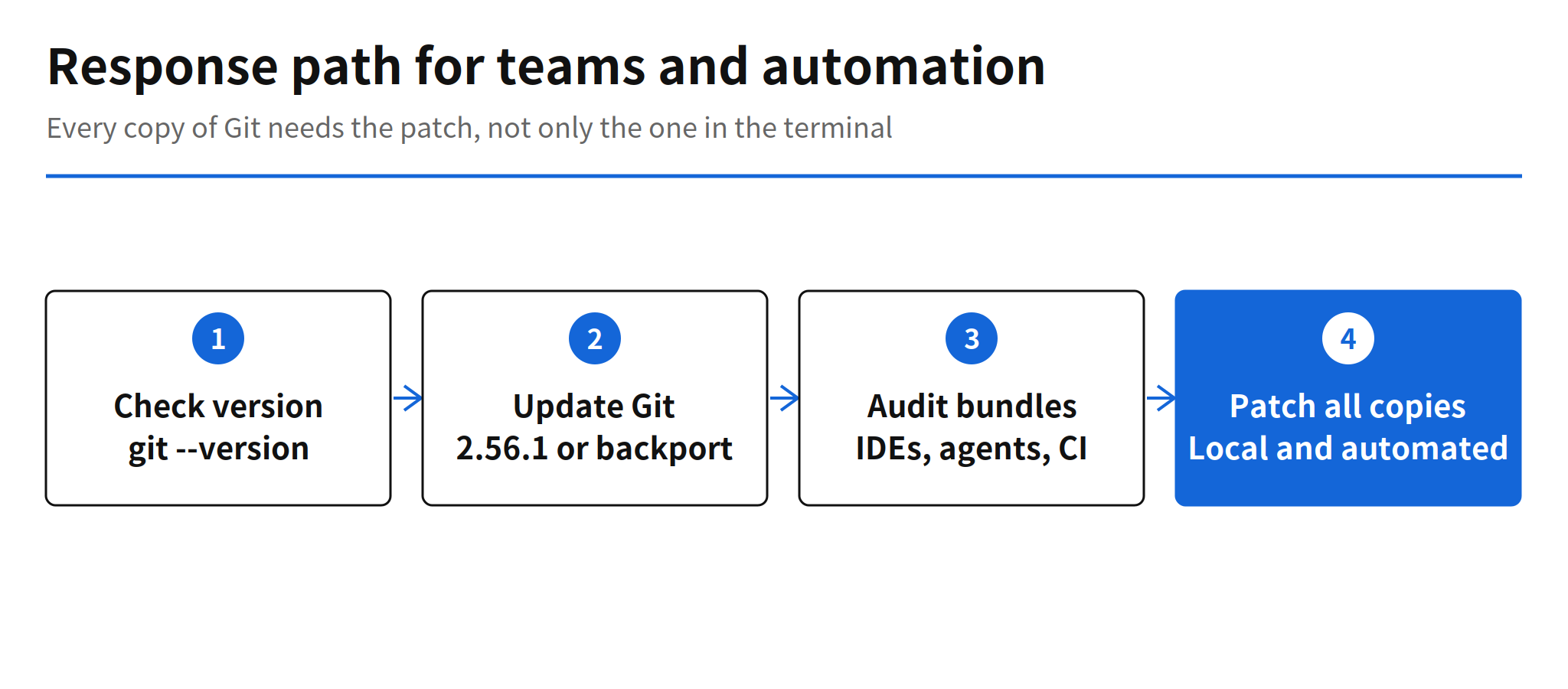
GitHub's guidance is to update every Git installation that processes repositories on someone else's behalf, including automation and services, not only developer laptops. In practice that means three inventories: the Git in the terminal, the Git bundled into IDEs and desktop apps, and the Git baked into CI images and agent runtimes. The third group is the easiest to miss and, for this vulnerability set, the most exposed, because agents clone and merge without asking first.
Until updating is possible, the official mitigation is to clone only from trusted servers and to avoid recursive clones of untrusted repositories. Merging untrusted content, applying binary patches and processing fast-import streams from untrusted sources should be avoided for the same reason.
For teams running coding agents, this release is a concrete reason to treat the agent's Git as part of the agent's own supply chain. An agent that fetches an unknown repository with submodules is exercising exactly the code path CVE-2026-111760 targets. Pinning the agent runtime to a patched Git, and rebuilding CI images instead of patching them in place, closes the gap in a way that a laptop-only update does not.
FAQ
What does Git 2.56.1 fix?
Git 2.56.1 fixes six vulnerabilities across clone, merge, binary patch apply and fast-import. The most serious is CVE-2026-111760, where a recursive clone can end up running attacker code through a submodule .git symlink.
Which Git versions received backported fixes?
The fixes were backported to 2.55.1, 2.54.1, 2.53.1, 2.52.1, 2.51.3 and 2.50.2, so older release lines can be patched without moving to 2.56.1.
Are GitHub services already patched?
GitHub says the fixes are already deployed on github.com and GitHub Enterprise Cloud, and GitHub Enterprise Server fixes are in 3.19.15, 3.20.11, 3.21.9 and 3.22.4. Patched Git builds for GitHub Desktop, the Copilot app, Codespaces and Actions were still being coordinated or planned, with completion unconfirmed.
What should teams do before they can update Git?
The official mitigation is to clone only from trusted servers and to avoid recursive clones of untrusted repositories. Merging untrusted content, applying binary patches and processing fast-import streams from untrusted sources should also be avoided until Git is updated.