Spacefast Release: Deploy Coding Agent Apps, Pricing
Automattic launched Spacefast on November 9, 2026, a new company built for one job: taking the apps and websites your existing AI agent builds and getting them online. You keep the AI you already use. Spacefast supplies the deployment path, the hosting, a custom domain and a database, then publishes the result to a private link where your team can leave comments.
The deliberate omission is the builder itself. Most AI app platforms bundle the tool that writes the app with the infrastructure that runs it, so moving an app built elsewhere means switching tools first. Spacefast unbundles the two halves. The agent receives build instructions and a database up front, builds inside its own environment, and hands the finished app to Spacefast for publication. That makes the product a shipping layer for agents rather than another agent.
How Spacefast Works
The flow starts before any code exists. Spacefast gives the connected agent its build instructions and a database first, so the app is written against the target runtime from the beginning instead of being adapted to it afterwards. When the app is ready, Spacefast publishes it to a private link. Team members open the link, comment on what they see, and those comments can go straight back to the agent as the next round of instructions.
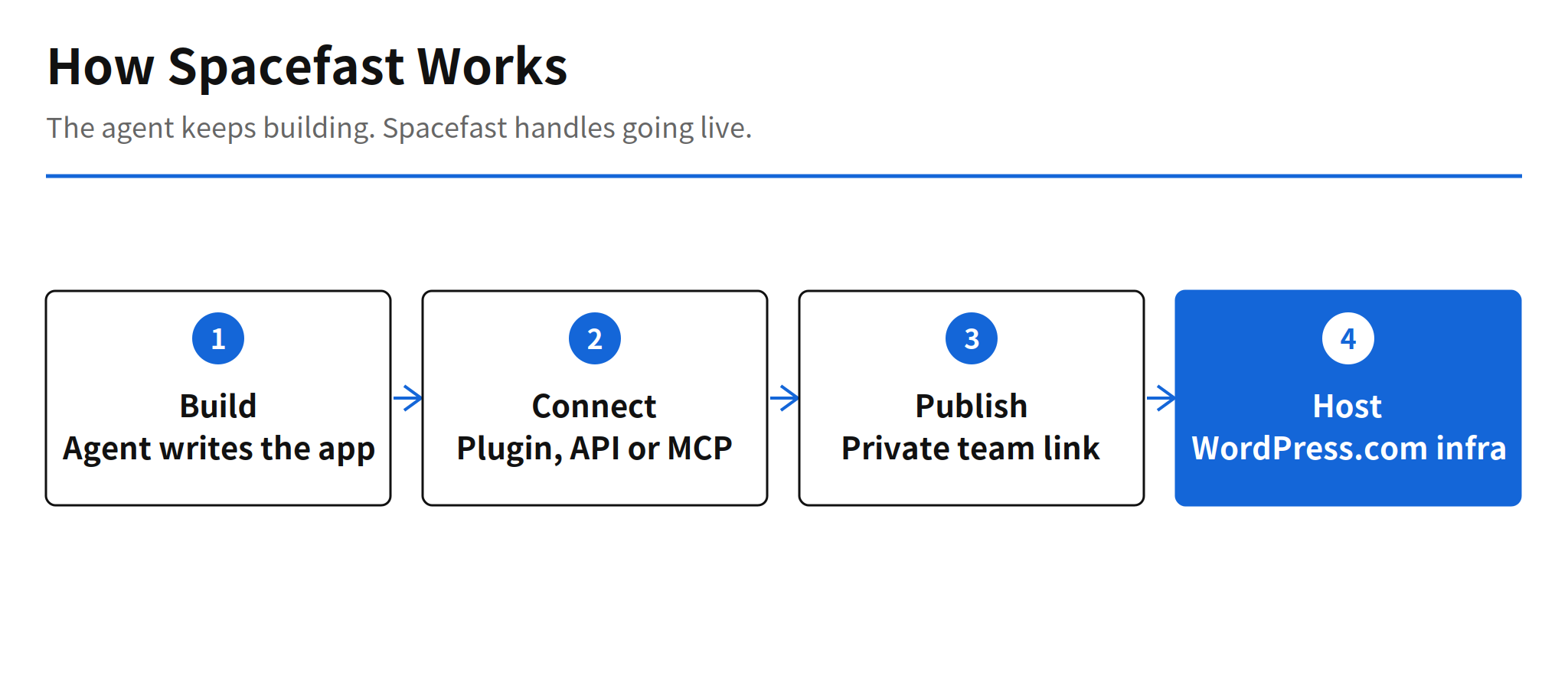
That comment loop is the practical difference from a plain hosting upload. A generated app usually stalls at the review step, where a screenshot or a staging link circulates and the feedback lands somewhere the agent cannot read. A private link with comments in one place closes the loop inside a single conversation, which is also how a personal prototype becomes a team asset instead of a file on one laptop.
Agents and Tools It Connects To
Automattic lists a wide connection surface. On the assistant side it names ChatGPT and the Claude apps, the personal assistants Muse and Dots, Claude Duet, Grok Bot and Instinct. On the coding side it names Claude Code, Codex, Cursor, OpenClaw and Hermes.
Spacefast is offered as an official plugin inside Claude, ChatGPT and Grok Bot. Any other AI can connect through its API, CLI or MCP interface. The breadth matters because the pitch only works if the deployment layer stays neutral: a team that mixes Cursor for one project and Claude Code for another can still publish both through the same place, with the same review habit.
Hosting, Supported Stacks and Pricing
Each published app gets deployment and hosting space, a custom domain and a database as part of the service. The supported stacks named in the announcement are Vite, TanStack Start, Next.js and Astro, which covers the frameworks vibe coding tools most often generate. Spacefast runs on WordPress.com infrastructure, and Automattic says that infrastructure handles more than 15 billion pageviews a month. That figure is Automattic's own, and it describes the parent platform rather than measured Spacefast traffic, but it does mean the hosting layer is not a new, unproven stack.
| Plan | Price, per the press release |
|---|---|
| Personal | Free to start, with $1 worth of usage included each month |
| Go | $5 per month |
| Pro | $15 per member per month |
The pricing is low enough that the real cost question is not the plan fee. It is the usage the included amounts cover once an app gets real traffic, and the announcement does not publish that metering detail. Plan naming also needs care, covered in the open questions below.
The Team and the Soft Launch Behind It
Spacefast's founder and CEO is Batuhan İçöz, who joined Automattic through the Texts acquisition. He built the first version alone during Radical Speed Month, an internal focused building period at Automattic. TechCrunch reported that Spacefast had already soft launched in September 2026, so the November announcement is a public debut for a service that has been running quietly for about two months. TechCrunch named Lovable and Emergent as competitors, both of which sit on the bundled side of the market that Spacefast is trying to split apart.
Open Questions and Limits
- Core app features are still missing. Built-in app authentication, transactional email and team knowledge sharing are not available yet. Automattic said they arrive in the coming weeks, without exact dates. Until auth ships, apps that need user accounts need another answer.
- Plan names disagree across sources. The press release calls the top plan Pro. A secondary report that checked the product site used the name Plus and mentioned 20 free spaces. Which naming is current is unconfirmed, so treat plan names other than the press release wording with caution.
- Moving away may cost code changes. DirtyStatic noted on November 9, 2026 that an app built for the Spacefast runtime can need code changes before it runs on another host. The size of that porting cost is not published. This is the flip side of building against Spacefast instructions from the start, and it is the number a team should probe before a serious project depends on the platform.
Related Reading
For another take on closing the gap between a coding agent and a live app, see the earlier report on Cursor Live Apps, which added Postgres, auth and deployment inside Cursor. Spacefast makes the opposite bet: the deployment layer stays outside the editor and works with whichever agent built the app.
FAQ
What is Spacefast?
Spacefast is a new company from Automattic, launched on November 9, 2026. It takes apps and websites built by the AI you already use and puts them online. Spacefast ships no AI builder of its own. Instead, the agent receives build instructions and a database first, then publishes the result to a private link where a team can comment.
Which agents and tools does Spacefast work with?
Automattic lists ChatGPT and the Claude apps, the personal assistants Muse and Dots, Claude Duet, Grok Bot and Instinct, plus the coding agents Claude Code, Codex, Cursor, OpenClaw and Hermes. Spacefast is an official plugin inside Claude, ChatGPT and Grok Bot. Other AI tools connect through its API, CLI or MCP.
How much does Spacefast cost?
It is free to start, according to the Automattic press release. The Personal plan includes $1 worth of usage per month for free, Go costs $5 per month, and Pro costs $15 per member per month. One secondary report used the name Plus for the top plan and mentioned 20 free spaces, so the current plan naming is unconfirmed.
What is Spacefast missing at launch?
Built-in app authentication, transactional email and team knowledge sharing are not available yet. Automattic said those features arrive in the coming weeks, without giving exact dates.