HyperFlow H3 Flash Release: Performance, Size and License
Video Rebirth released HyperFlow H3 Flash on November 6, 2026, in the GitHub repository Video-Rebirth/hyperflow-h3-flash. It is a compressed, few-step version of MiniMax-H3 that generates video together with synchronized stereo audio. The transformer is 13.7B parameters in the fl2va variant and 13.9B in ref2va, less than half of the roughly 31B transformer in MiniMax-H3.
The practical claim is local reach. A GGUF quantization called Q4_K_M is 9.1 GB, and the README says it runs on 24 GB and 32 GB GPUs in a PC with 16 GB of system RAM. Sampling takes 4, 6 or 8 steps, with 6 as the default, and no classifier-free guidance. For a local ComfyUI workflow, that combination turns a data center scale video model into something a single workstation can at least attempt.
Output Format and Sampling Steps
The output is 24 fps video of 5.2 to 15 seconds, at a default size of 1344x768, with a 32 kHz stereo soundtrack. MiniMax-H3 reads text, image, video and audio in one context and produces sound with the picture, and HyperFlow keeps that paired output while cutting the step count. A short step budget matters more than it first appears, because video sampling repeats the model for every step, so moving from a long schedule to 4 to 8 steps cuts the total compute per clip by a wide margin.
Three task types are supported. Text to video and audio is t2va. First and last keyframe generation is fl2va. Reference based generation is ref2va, with up to 12 references. The repository code is Apache-2.0, and the release ships ComfyUI nodes plus run paths through Unsloth Studio and stable-diffusion.cpp, so the intended home is an existing local pipeline rather than a hosted demo page.
Reported Speed on Three GPU Setups
For a 5.2 second clip at 6 steps, the README reports 8.7 seconds on 4x B200, 36 seconds on 1x H200 and 92 seconds on 1x RTX 5090. The consumer figure is the one to read carefully. Ninety-two seconds for a five second clip is not realtime, but it is short enough for iterative local testing, where a creator can try a prompt, inspect the result and adjust without paying per generation or waiting in a hosted queue.
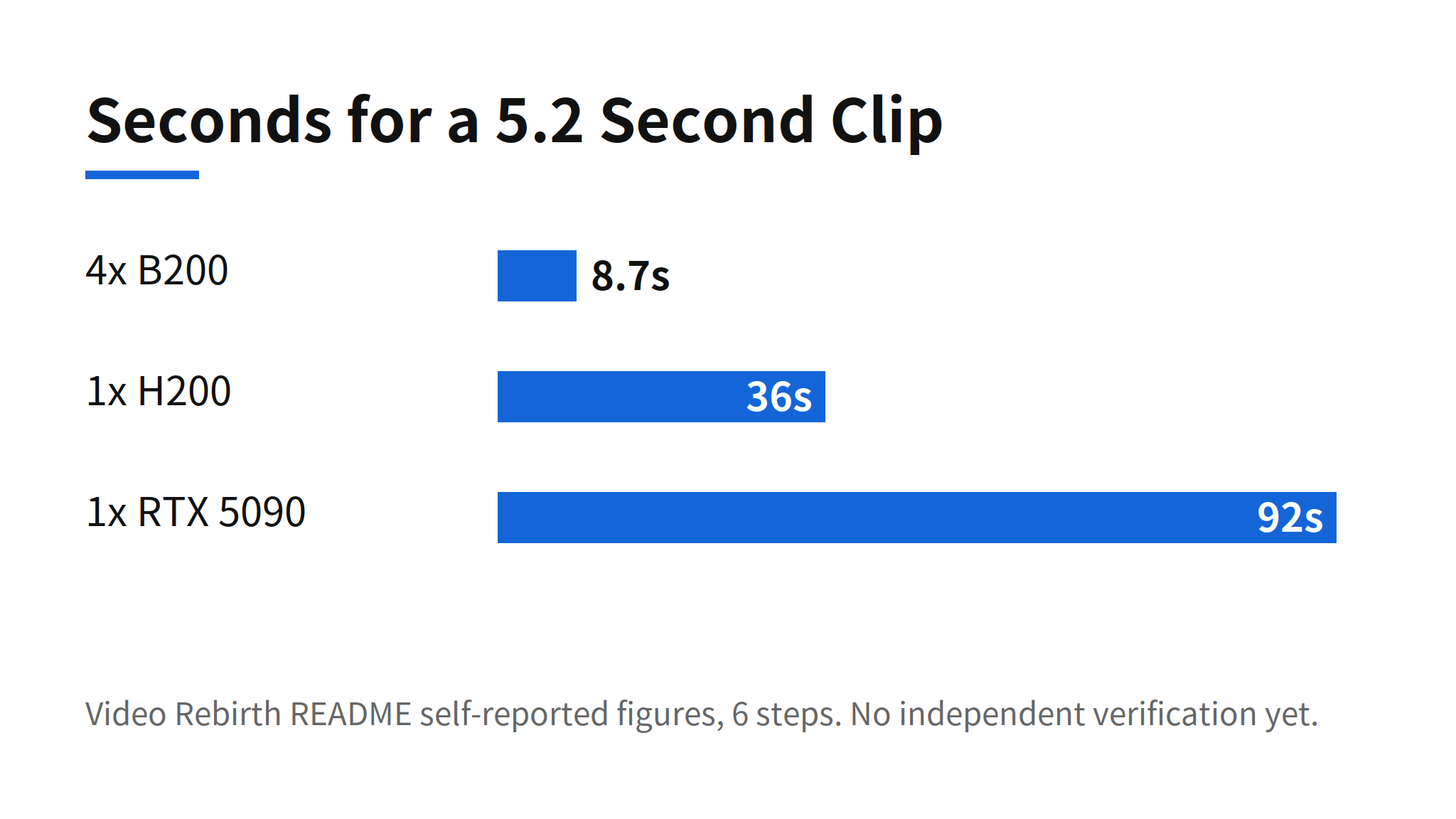
These numbers are self-reported. No third party has reproduced them, and the README gives no side by side quality measurement against the full MiniMax-H3. Speed at a smaller step count is only useful if the output holds up, and that comparison is exactly the piece still missing.
Compression From 31B to 13.7B
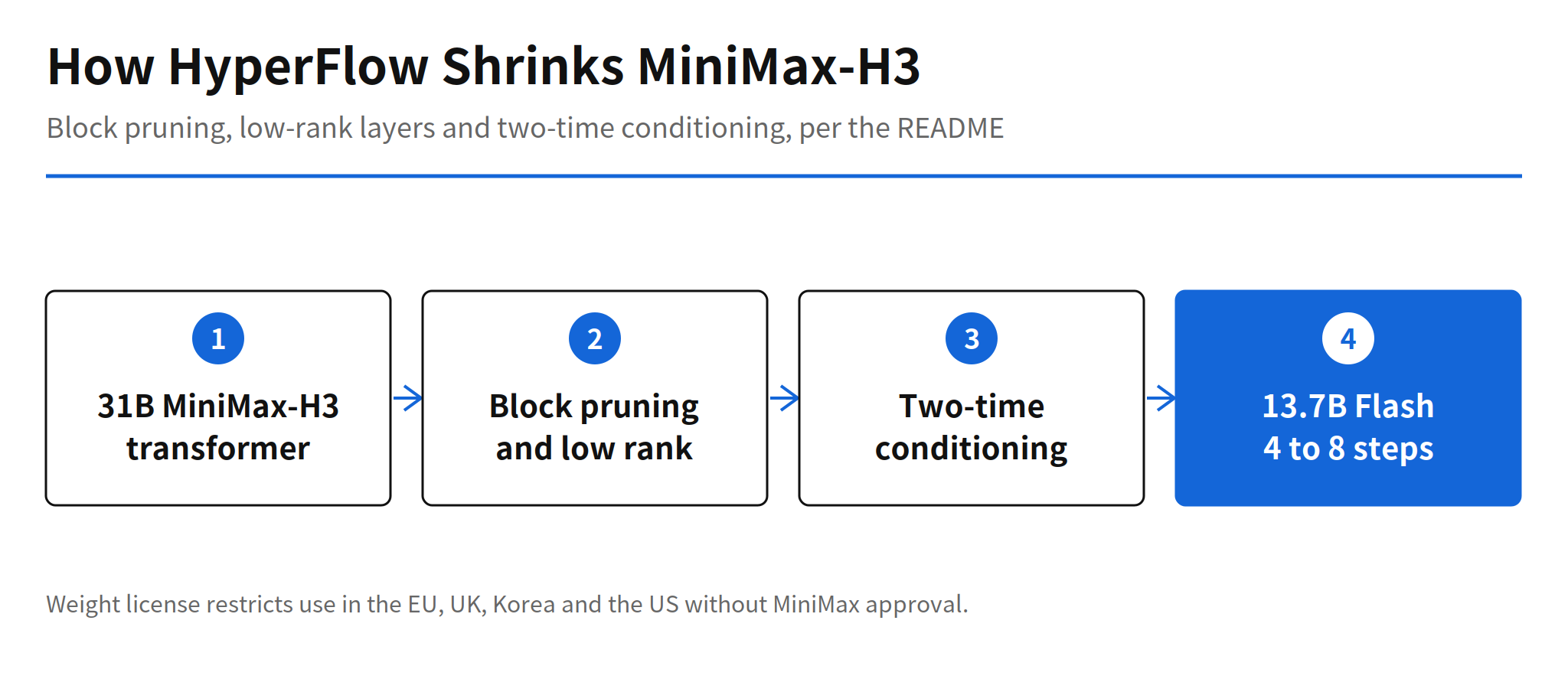
The README describes the size cut in three parts: blocks are removed, low-rank linear layers replace heavier ones, and a two-time conditioning scheme supports the few-step schedule. That approach differs from an adapter. Pika previously shipped a LoRA adapter that attaches to H3, while HyperFlow reduces the transformer itself. A smaller base model changes the memory floor for every downstream tool, which an adapter cannot do, because the full model still has to load underneath it.
The GGUF sizes show the same trade at the file level. Q4_K_M is 9.1 GB and Q8_0 is 14.9 GB, so a user can pick between a lighter file and a higher precision one within the same release. Weights are also published on Hugging Face as VideoRebirthAI/hyperflow-h3-flash.
Weight License Limits in Korea and Three Other Regions
The code license and the weight license point in opposite directions. The code is Apache-2.0, which is permissive. The weights follow the MiniMax H3 Community License Agreement, and that agreement does not guarantee use in the European Union, the United Kingdom, Korea or the United States without MiniMax approval. A reader in Korea should therefore treat this repository as a reference for the compression technique, not as a model they can simply download and run for work.
Two more gaps belong on the same caution list. Performance on a 16 GB GPU has not been measured, according to the README, so owners of smaller cards have no evidence yet. And with no published quality comparison against full size MiniMax-H3, the size and speed gains have no measured cost attached to them. Both gaps are stated in the source material itself, which is a better sign than silent omission, but they still limit what a careful adopter can conclude today.
Related Reading
For a hosted counterpart with per second pricing, see the report on Gemini Omni 1.2 Flash and its 15 second video generation. The contrast is useful: hosted models sell convenience and predictable billing, while a release like HyperFlow sells control over the pipeline at the cost of hardware and license homework.
FAQ
What is HyperFlow H3 Flash?
HyperFlow H3 Flash is a compressed, few-step version of MiniMax-H3 released by Video Rebirth on November 6, 2026. It generates video with synchronized stereo audio, using a transformer of 13.7B parameters for the fl2va variant or 13.9B for ref2va, down from about 31B in MiniMax-H3.
How fast is HyperFlow H3 Flash?
The README reports a 5.2 second clip at 6 steps taking 8.7 seconds on 4x B200, 36 seconds on 1x H200 and 92 seconds on 1x RTX 5090. These are Video Rebirth self-reported figures with no independent verification yet.
What hardware does the GGUF version need?
The Q4_K_M GGUF file is 9.1 GB, and the README says it runs on 24 GB and 32 GB GPUs in a PC with 16 GB of system RAM. Performance on a 16 GB GPU has not been measured yet.
Can the weights be used in Korea?
The weights follow the MiniMax H3 Community License Agreement, which does not guarantee use in the European Union, the United Kingdom, Korea or the United States without MiniMax approval. The repository code itself is Apache-2.0.