LeRobot v0.7.0 Release: Prompt Robots, Stream 300 TB
Hugging Face released LeRobot v0.7.0 on November 5, 2026, with the GitHub release published at 17:13 UTC that day. The headline change is interactive rollout: a robot that is already working can take spoken or typed instructions mid-task, without stopping the run. The second change is data access. Nearly 300 TB of open Physical AI data in LeRobot format now sits on the Hugging Face Hub, and v0.7.0 can stream it during training instead of downloading it first.
LeRobot is the open-source library that ties robot policy training, execution, and data sharing into one project. It is written in Python, carries the Apache-2.0 license, and stood at 28,723 GitHub stars as observed on November 7. Version 0.6.0 added language annotations to datasets. Version 0.7.0 connects those annotations to the execution stage, so a policy that reads and writes language can also accept a human correction while it acts. That connection is what makes the new interaction model possible, and it is also the clearest sign of where the project is heading: the interface patterns of agent software, applied to physical machines.
Interactive Rollout Without Stopping the Robot
Adding --interactive=true to lerobot-rollout exposes three commands during a run. /subtask changes the task the robot is pursuing. /vqa asks the policy about the scene it currently sees. /autosteer gives only a goal, and the policy selects the subtasks itself. Each command addresses a different level of operator involvement, from a direct correction to a hands-off goal statement, and all three work while execution continues.
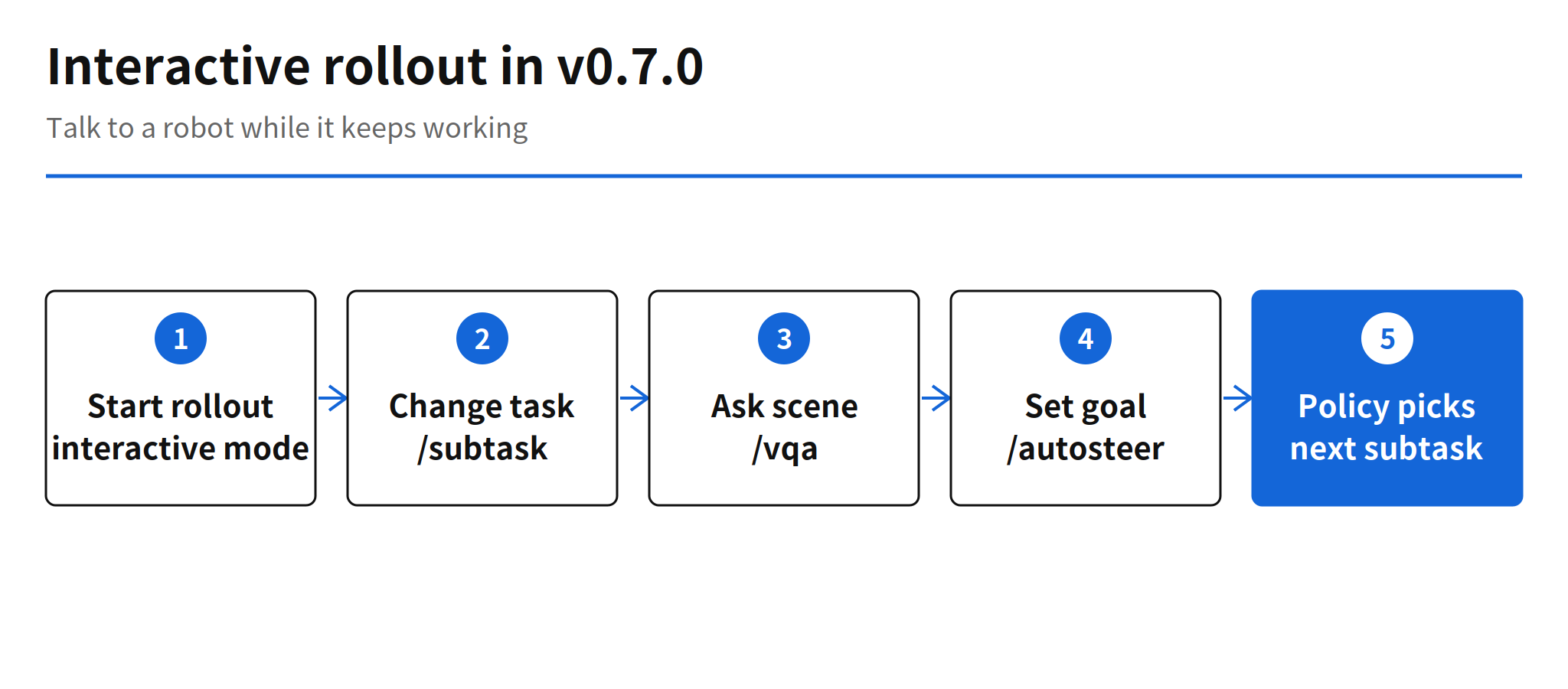
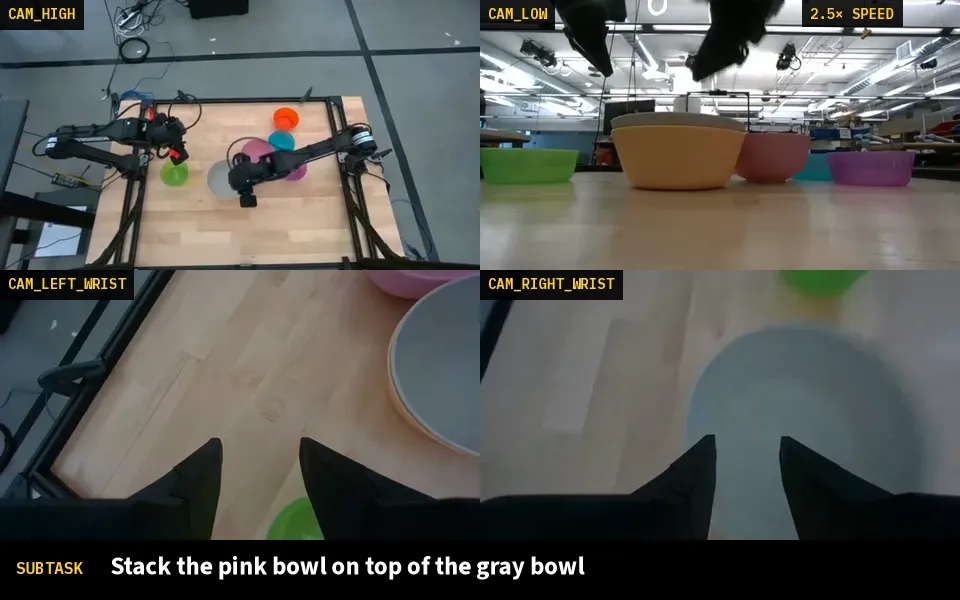
The practical value is iteration speed. Robot trials are slow and physical, and a run that has to be stopped and restarted for every instruction change wastes the scarcest resource in the loop, which is working robot time. Mid-run steering turns one long trial into a sequence of adjustable attempts. The limit is equally clear. Steering quality depends on how well the policy grounds language in the current scene, and the release materials do not provide a separate measurement for instruction changes made mid-task. The feature is shipped and documented; its reliability under messy real conditions is still an operator-side question.
Eight New World and Vision-Language Models
Four world action models are new in this release: Cosmos 3, Long-WAM, FLUX 3 Action, and LaWAM. Four vision-language-action models join them: G0.5, LingBot-VLA 2.0, DM0.5, and Wall-OSS-0.5. Adding eight models in one release widens the choice of policy architectures that run inside the same training and rollout tooling, which matters more than any single model addition. A shared harness makes models comparable on the same data and the same robot, instead of each arriving with its own incompatible scripts.
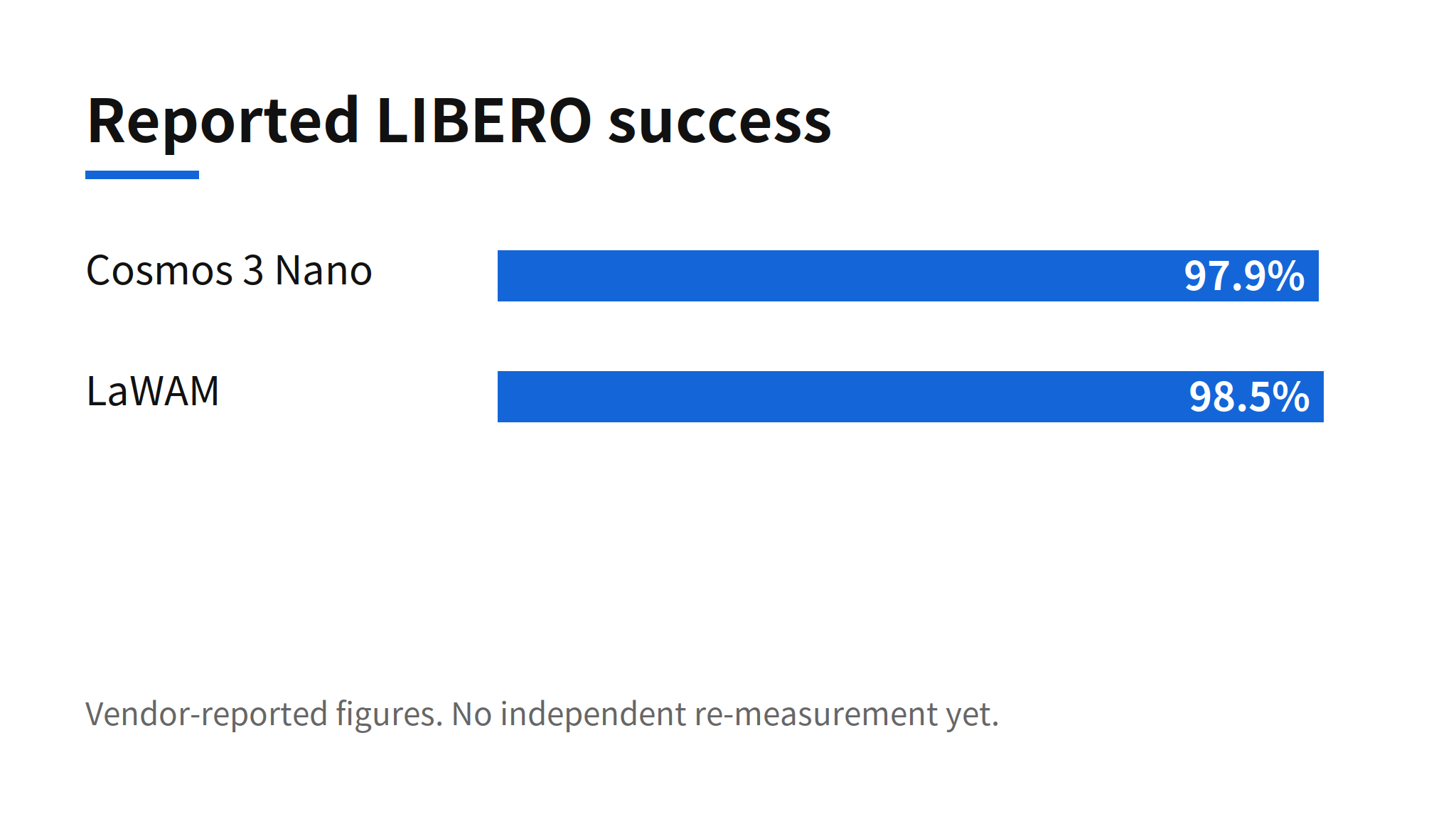
The reported numbers are strong and need their caveat attached. Cosmos 3 Nano, at 16.5B parameters, is reported at a 97.90% average success rate on LIBERO. LaWAM is reported at 98.5%, which is 1,970 successes in 2,000 episodes. Both values were reported by the model providers. No third party has re-measured them under the same conditions, so they work as a guide to what the providers claim, not as a verified ranking. Readers comparing policies should treat the chart above as vendor data and wait for shared-benchmark replication before drawing ordering conclusions.
Streaming 300 TB Without Downloading It
The Hub now holds nearly 300 TB of open Physical AI data in LeRobot format. From v0.7.0, training can stream that data directly from the Hub, from Storage Buckets, or from LanceDB. The bottleneck this removes is concrete. A small team that wants to train on a large shared corpus previously needed local storage and transfer time on the same scale as the data itself, which quietly restricted large-corpus training to groups with serious infrastructure. Streaming moves the requirement from owning a copy to having a connection, and it shortens the path from finding a dataset to running a first training job on it.
Streaming has its own costs, and they show up during long training runs rather than at setup. Throughput and interruptions depend on the network path, and repeated epochs re-read data that a local copy would serve from disk. The release removes the download barrier; it does not remove the need to plan data throughput for a serious training schedule. For evaluation, prototyping, and the first epochs of a new project, though, the trade is clearly favorable.
A Rebuilt Training Stack and Remote Inference
The training stack was rebuilt on FSDP2 and HSDP sharding with distributed checkpointing. On an 8 x H200 node, checkpoint saving for the 6B FastWAM model became 3x faster, and peak memory per GPU when resuming fell from 143 GB to 42 GB. The memory figure is the one with operational weight. A resume peak of 143 GB per GPU decides which hardware a interrupted job can restart on; 42 GB widens that set considerably and makes checkpoint and resume a routine operation instead of a capacity problem.
Large policies can also move off the robot entirely. With lerobot-policy-server, inference runs on a remote GPU while the computer next to the robot handles only cameras and motors. The robot keeps executing buffered actions while the server computes the next chunk, so the split is designed around latency rather than pretending it does not exist. Even so, how much network delay a given setup tolerates before behavior degrades is environment-specific and unmeasured in the release materials. Teams evaluating remote inference should test it on their own network before trusting it near people or fragile objects.
FineART and the Scale of Open Robot Data
The release also highlights FineART, a dataset from Scale AI and Hugging Face with more than 40,000 dual-arm episodes covering 1,718 hours, more than 533,000 subtask annotations, and a total size of 1.9 TB. The annotation density is the point. Subtask labels at that granularity are what allow a policy to learn and later follow the language structure that interactive rollout depends on. Data of this shape, released openly and in the same format the library streams, feeds directly into the feature set at the top of this release.
Compatibility Changes and Unconfirmed Claims
Two changes will break existing setups. Remote inference replaces the old lerobot.async_inference module and the lerobot[async] extra, and both were removed in v0.7.0. Upgrades need the new remote extra instead. Experiment tracking changes at the same time: Trackio now fully replaces Weights and Biases. Neither change is hidden, but both belong in an upgrade checklist, because a pipeline that installs the old extra or expects the old tracking integration will fail after the version bump.
The open items are the model scores and the remote inference latency noted above. The LIBERO figures are provider-reported, and safe latency limits for remote policies vary by environment. Everything else in this release, from the streaming sources to the checkpoint numbers, is stated directly in the Hugging Face release materials with enough specificity to test on a first upgrade.
Related Reading
For another open robot learning release built around shared demonstrations, see the report on Ai2 ToyBlocks and its robot learning testbed. For agents that keep working across surfaces while a user steers them, see Kiro Bots and persistent agents.
FAQ
What is new in LeRobot v0.7.0?
The headline change is interactive rollout. With --interactive=true on lerobot-rollout, an operator can change the task with /subtask, ask about the scene with /vqa, or give only a goal with /autosteer while the robot keeps running.
How does training work without downloading 300 TB?
The Hub now holds nearly 300 TB of open Physical AI data in LeRobot format. Version 0.7.0 can stream that data directly from the Hub, from Storage Buckets, or from LanceDB instead of downloading it first.
Which models were added in this release?
Four world action models arrived: Cosmos 3, Long-WAM, FLUX 3 Action and LaWAM. Four vision-language-action models arrived as well: G0.5, LingBot-VLA 2.0, DM0.5 and Wall-OSS-0.5.
What breaks when upgrading to v0.7.0?
Remote inference replaces the old lerobot.async_inference module and the lerobot[async] extra, and both were removed in v0.7.0. Installs need the new remote extra instead. Trackio also fully replaces Weights and Biases for experiment tracking.