DigitalOcean Cuttlefish Release: iPhone Agent Supervision
DigitalOcean launched Cuttlefish on November 5, 2026 at BoxWorks, a native iPhone app for its Managed Agents service. The app streams a running agent session live, including answers, reasoning and tool calls, and it sends an alert when a run waits for approval, finishes or fails. Tool calls can be approved or rejected from the phone after reviewing the full command, the file path and the diff, and requests classified as high risk require Face ID or a passcode.
The product targets a specific stall in long agent runs. Managed Agents moved execution from a laptop into hosted sessions that keep running after the laptop closes, which solved the machine side of the problem. The human side stayed behind, because a session that stops to ask for permission waits until someone is back at a desk. Cuttlefish moves that approval point to the phone, so the wait depends on a notification being answered rather than on a person returning to a keyboard.
That shift also changes what supervision means in practice. The owner is no longer the person writing each step. The owner watches a stream, judges the risky moments and intervenes when the direction is wrong. Cuttlefish is built around that narrower and more realistic role, and its controls follow from it.
Live Streaming and Approval Controls
A session in Cuttlefish is not a summary after the fact. Answers, reasoning and tool calls stream in as the agent works, and the alert arrives at the moment the run needs a decision. The approval screen shows the full command, the file path and the diff, which matters because an approval is only as good as the information behind it. A short label such as a tool name would ask the owner to trust the agent at exactly the point where the system is designed to check it.
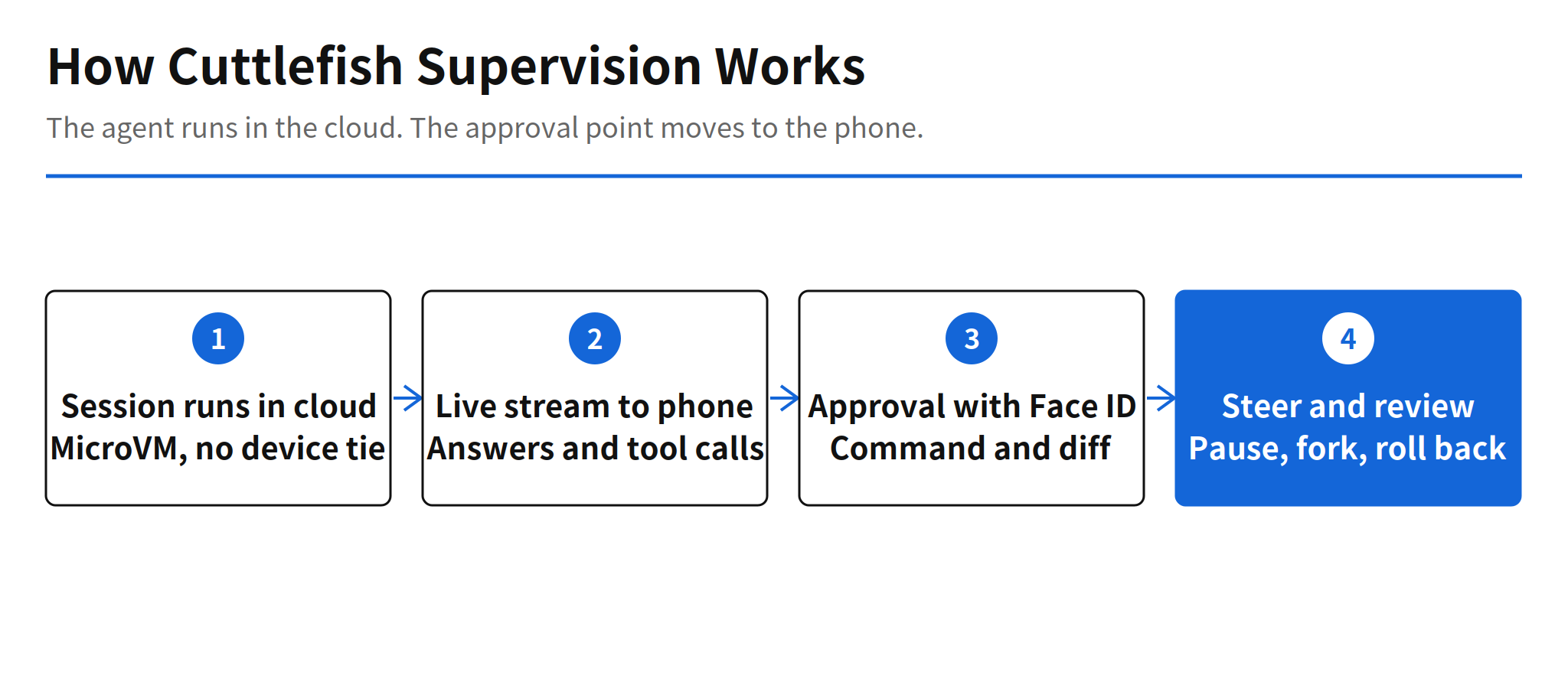
The Face ID and passcode requirement for high risk requests adds friction in the right place. Approving a routine step stays fast, while a destructive or sensitive command cannot be cleared with a single distracted tap. The classification itself is the part teams cannot inspect from the announcement, and it decides how much protection this design actually gives. If too much is classed as routine, the extra check rarely fires. If too much is classed as high risk, owners start approving reflexively, and the gate weakens in a different way.
Steering, Results and Checkpoints
Supervision in Cuttlefish goes beyond a yes or no at approval points. The owner can send a correction while a run is in progress, pause it, resume it or stop it. Messages sent while the agent is busy are queued and carried into the next task, so an instruction given mid run is not lost when the current step finishes.
Results stay inside the same app. Websites and documents the agent produced can be opened there, workspace files can be browsed, and the owner can create checkpoints, fork a session or roll one back. That makes the phone a review surface as well as an approval surface. For a short run this is a convenience. For a run that lasts hours, it is the difference between checking progress in seconds and postponing the review until the work is stale.
Harness Choice and MicroVM Sessions
Managed Agents does not tie a team to one harness. DigitalOcean lists Claude Code, Codex CLI, OpenCode, OpenHands, Hermes, LangGraph and CrewAI as supported, and the team picks the model and tools for each job from a catalogue the company puts at more than 20,000 tools. One supervision app covering several harnesses matters for teams that switch tools, because the approval habit and the audit trail stay in one place while the underlying agent changes.
Sessions run in a MicroVM hosted by DigitalOcean. A session is not tied to any single device and it persists independently, and billing follows active CPU use, which keeps the cost of an agent waiting for input low according to the announcement. That pricing detail pairs directly with the supervision problem. If waiting were expensive, a stalled approval would burn money as well as time, and the pressure to approve quickly would work against careful review.
Box Mount and the Deletion Risk
Announced alongside Cuttlefish, Box Mount syncs a Box folder into a Managed Agents session. It is in private preview. Changes and deletions made by the agent sync back to Box, and changes made in Box appear in the workspace, while Box permissions, version history and audit records continue to apply.
For teams already storing work in Box, the mount removes the manual step of copying files into an agent workspace and copying results back. The trade is that the agent now works on live files under live permissions. A narrow folder with only the files a job needs is a safer starting point than a broad mount of a shared drive, and the announcement gives no reason to treat that caution as optional.
Availability and Unconfirmed Pricing
The three pieces sit at different stages. Cuttlefish is available on the App Store from launch day for Managed Agents customers. Managed Agents itself is in public preview, and Box Mount is in private preview. The announcement states that preview services can change or be discontinued, and final pricing and a general availability date are unconfirmed.
The supervision app is also iPhone only. No Android plan appears in the announcement, so a team with Android carrying supervisors cannot adopt the mobile approval loop yet. That gap is worth stating plainly because approval coverage is only real if the person on duty carries a supported phone. A workflow that depends on one platform for its safety step inherits that platform limit.
Related Reading
For another hosted agent service with its own skills and pricing model, see the earlier report on Kimi Hosted Agents, its pricing and skills. For a different answer to the supervision problem, built around named agents with standing briefs and escalation rules, see Perplexity Teammates and its persistent agents.
FAQ
What is DigitalOcean Cuttlefish?
Cuttlefish is a native iPhone app for DigitalOcean Managed Agents, launched on November 5, 2026. It streams agent sessions live, sends alerts when a run waits for approval or ends, and lets the owner approve or reject tool calls from the phone.
How do high risk approvals work in Cuttlefish?
A tool call is shown with its full command, file path and diff before it runs. Requests classified as high risk require Face ID or a passcode, so a single tap on a notification is not enough to approve them.
Which agent harnesses does Managed Agents support?
DigitalOcean lists Claude Code, Codex CLI, OpenCode, OpenHands, Hermes, LangGraph and CrewAI as supported harnesses. Teams choose the harness, the model and tools for each job, with more than 20,000 tools available according to the company.
Is there an Android version of Cuttlefish?
No Android plan appears in the announcement. Cuttlefish launched as an iPhone only app, while Managed Agents itself is in public preview and Box Mount is in private preview.