LaunchDarkly Release Autopilot: AI Code Release Control
LaunchDarkly announced Release Autopilot on November 4, 2026, an automation layer that manages how AI-written code reaches production. An agent evaluates each incoming change, classifies the risk of the pull request, and opens a pull request of its own that wraps the change in a feature flag when one is needed. The rollout then proceeds in stages under guardrail metrics the team defines. If those metrics move the wrong way, the release halts or rolls back automatically, and once a release succeeds, the system files the cleanup work itself: a pull request that removes stale code and archives the flag.
The short version is that LaunchDarkly is moving the agent one step downstream. Coding agents already write and merge code at a pace human release processes were not built for. Release Autopilot applies the same agent pattern to the release itself, and it does so on top of a platform that, by the company's account, already evaluates 70 trillion flags a day. General availability is set for November 16, with some features shipping as beta, and a free trial is open now.
Release Risk as the New Bottleneck
The announcement is built on a shift that most teams shipping agent-written code can already feel. The bottleneck moved. Writing code got cheap, so the scarce resource is now confidence: who reviewed this change, which signal would prove it is safe, and how fast can it be withdrawn if it is not. LaunchDarkly's own survey work points at the same tension. In its 2026 AI Control Gap Report, 94% of respondents said AI made them write code faster, and 91% said they have become more cautious about deploying to production. Speed and caution are rising together, and the gap between them is exactly where release process lives.
LaunchDarkly frames its answer as risk management rather than code quality. The company is not claiming the agent writes better code. The claim is that the release around the code can be made systematic: every change gets a risk read, risky changes get flags, rollouts advance only while guardrail metrics stay healthy, and reversal is a built-in step rather than an incident-time improvisation. That framing matters because it decides what the product has to be good at. A quality tool is judged on the code it produces. A release control layer is judged on blast radius and time to recover.
The practical question for a team is no longer whether agents can write the change. It is whether the path from merge to full rollout can run itself, and stop itself, at agent speed.
How the Autopilot Loop Works
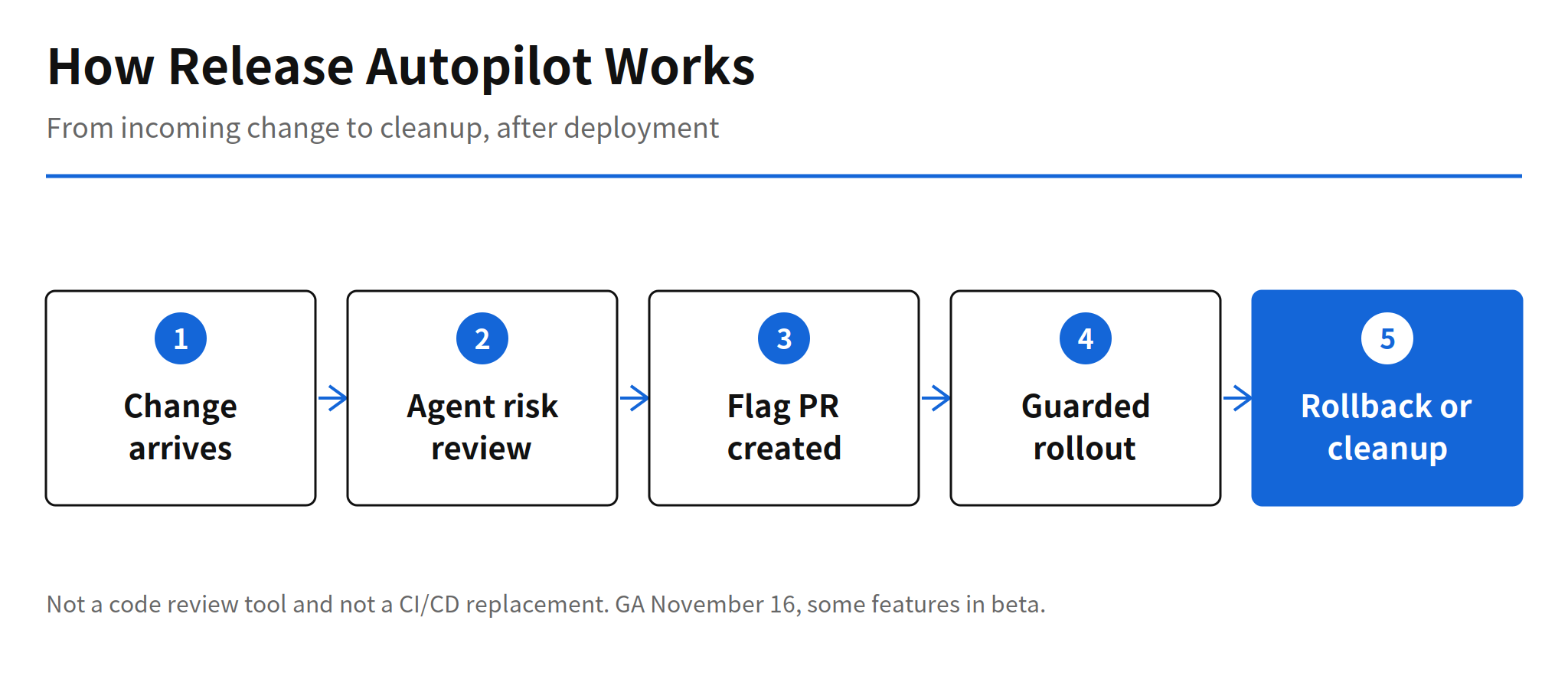
- Risk assessment comes first. When a change arrives, an agent evaluates the pull request and classifies its risk, so low-risk changes and risky ones do not have to travel the same path.
- Flags are added by pull request. Where a change needs a feature flag, the system opens a pull request that adds one, keeping the mechanism inside the review tools teams already use.
- Rollout is staged and watched. Exposure grows in stages while guardrail metrics chosen by the team are monitored continuously.
- Reversal is automatic. If the metrics move in a bad direction, the release stops or rolls back without waiting for a human to notice and intervene.
- Cleanup is part of the loop. After a successful release, the system submits the pull request that removes stale code and archives the flag, the step teams most often postpone until flags pile up.
That last step deserves attention. Feature flag debt is a known failure mode of flag-heavy release processes: flags that were meant to live for a week stay for a year, and nobody can say which code paths are still live. Automating the removal pull request does not solve the judgment call of when a flag is truly done, but it removes the mechanical excuse for never getting to it.
The Numbers Behind the Launch
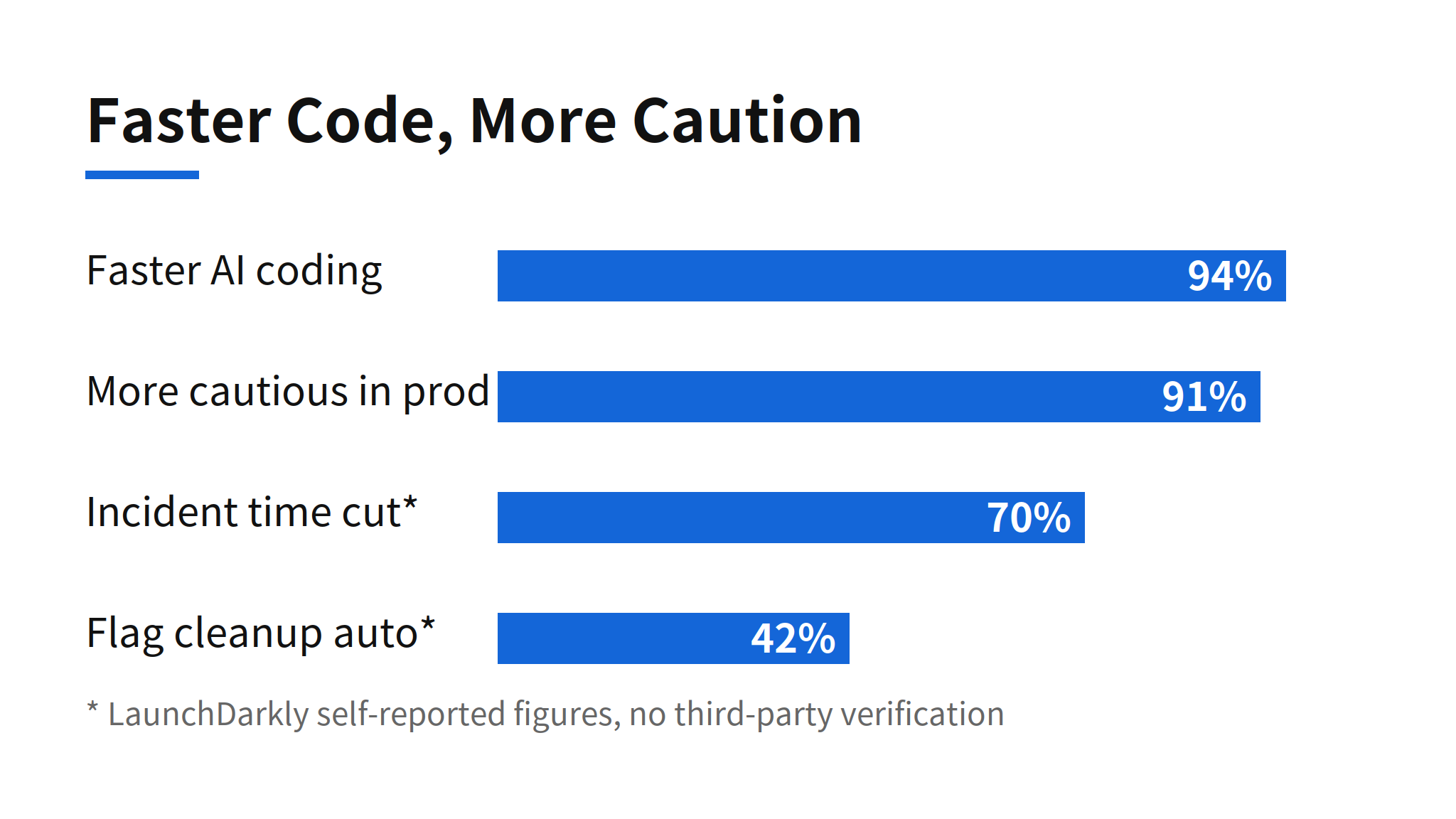
The survey figures above describe the market LaunchDarkly is selling into. The company also published operational numbers from its own platform experience, and those need a different level of trust. They are vendor claims, stated by LaunchDarkly about its own operation, with no third-party verification published alongside them.
Vendor-reported figures, not independently verified. LaunchDarkly states that more than 20% of pull requests now reach production through agents with no human review, that monthly merged pull requests more than doubled in a year at roughly flat engineering headcount, and that feature flag creation grew nearly fourfold. The company also states that automation now handles 42% of flag removal and that time spent on Major and Critical incidents fell by about 70%. Treat these as the seller's account of its own platform, useful as a claim to test after November 16 rather than as measured fact.
Read carefully, the 20% figure is the most consequential of the set. If a fifth of production changes already arrive without human review on a platform of this scale, then release safeguards are not a precaution for a future workflow. They are the control surface for a workflow that is already running, which is the strongest version of LaunchDarkly's pitch and also the part most worth verifying independently.
Scope and Limits of the Automation
LaunchDarkly is explicit about what Release Autopilot is not. It is not a code review tool, and it does not replace a CI/CD pipeline. It sits after deployment, in the layer where a change meets real users, and it runs on the existing flag platform rather than as a separate system. Teams keep their review and pipeline tooling; the autopilot governs exposure, monitoring, reversal and cleanup.
That scope is also the honest way to evaluate it. An automatic rollback is only as good as the guardrail metrics it watches, and metric selection remains a human design decision. A team that picks vanity metrics gets an autopilot that confidently ships bad changes in stages. The product automates the mechanics of a release policy; it does not write the policy. For mobile and client teams, including Android teams shipping through staged store rollouts, the mapping is direct: flag coverage, staged exposure, a watched error budget and a rehearsed reversal are the same discipline, whether the console is a store dashboard or a flag platform.
Open Questions Before General Availability
- Guardrail defaults are unpublished. The default metrics and thresholds the rollback decisions rely on have not been disclosed in the launch material, and neither has the accountability boundary when an automatic rollback fires wrongly.
- The beta list for November 16 is unspecified. General availability is dated, but which features remain in beta at that point has not been stated yet.
- The operational numbers are self-reported. The 20% agent-to-production share and the incident time reduction come from LaunchDarkly's own account, with no independent verification available at announcement time.
None of those gaps change what the launch signals. A major release platform has decided that the unit of automation is no longer the change or the deployment, but the whole release lifecycle around AI-written code, including the cleanup at the end. Whether Release Autopilot itself becomes the standard tool matters less than the fact that this loop is now a product category with a ship date.
Related Reading
For another case of agent infrastructure cutting the cost of running coding agents, see the report on Claude Code background subagents and status line cost. For coding agent tooling moving into background execution, see Claude Code 2.1.319 and background MCP tasks.
FAQ
What is LaunchDarkly Release Autopilot?
Release Autopilot is a LaunchDarkly feature, announced on November 4, 2026, that automates release safeguards for AI-written code. An agent evaluates incoming pull requests and classifies their risk, opens a pull request that adds a feature flag where one is needed, then runs a staged rollout watched by guardrail metrics, with a halt or automatic rollback when metrics move the wrong way.
When does Release Autopilot become generally available?
General availability is November 16, 2026, and some features will be in beta at launch. LaunchDarkly says teams can start now with a free trial.
Does Release Autopilot replace code review or CI/CD?
No. LaunchDarkly states that Release Autopilot is not a code review tool and does not replace a CI/CD pipeline. It automates the layer after deployment, where a change actually reaches users, and it runs on the existing LaunchDarkly platform.
What do the 94% and 91% figures mean?
They come from LaunchDarkly's 2026 AI Control Gap Report. In that survey, 94% of respondents said AI made them write code faster, while 91% said they have become more cautious about deploying to production.