OpenIDEA Rebuilds IntelliJ IDEA in Rust: 169 MB Memory
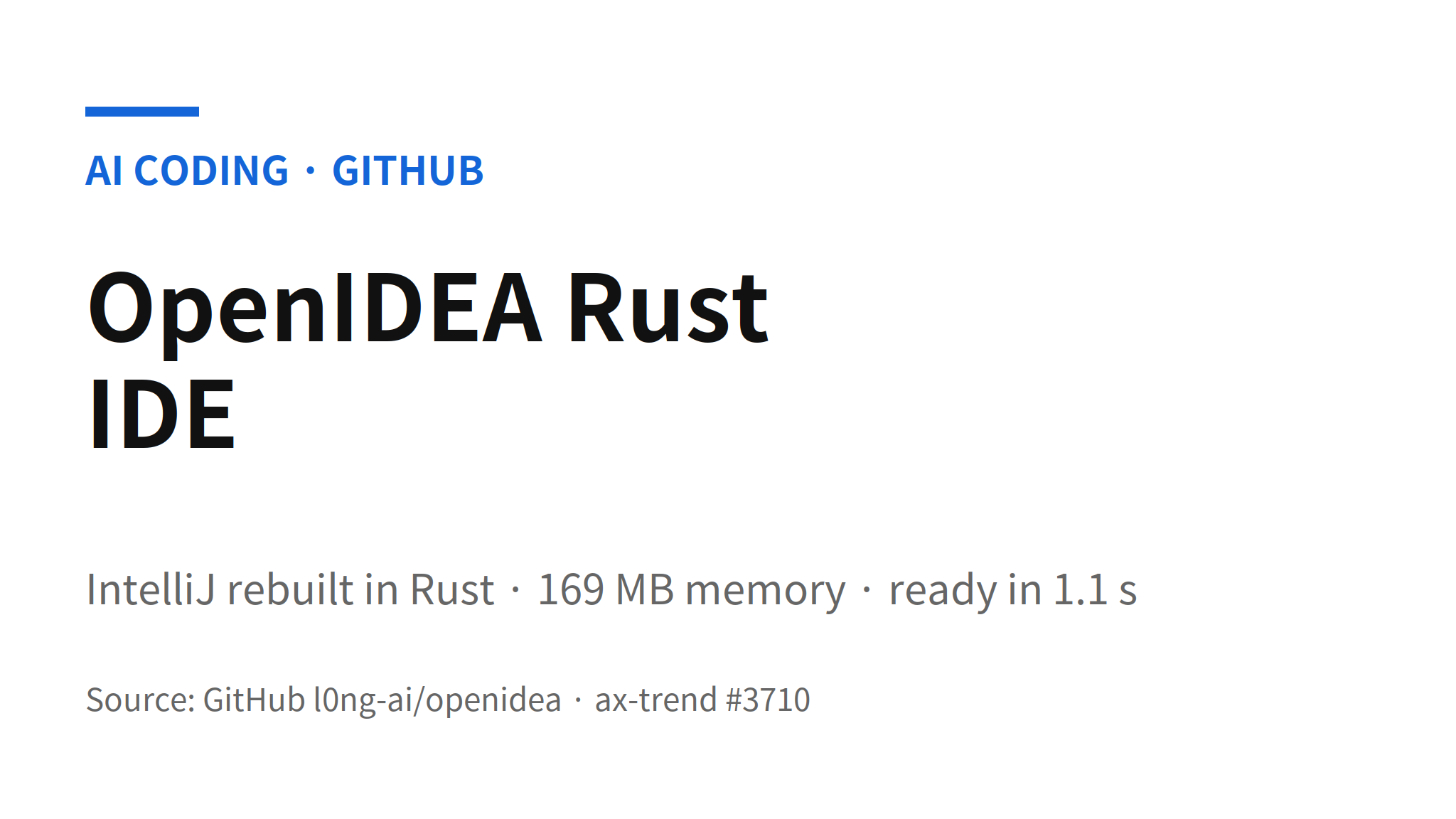
OpenIDEA keeps the IntelliJ IDEA way of working and replaces the heavy runtime underneath it. The project from l0ng-ai reimplements the IDEA-style keymap, tool windows and Search Everywhere in a native app with a Rust core. Its README benchmark puts memory at 169 MB against 2,011 MB for IntelliJ IDEA 2026.2.3, with ready time at 1.1 seconds against 13.2 seconds. Those are the author's own measurements. The README itself adds the caveat that IDEA analyses Python more deeply, so ready does not mean the same work on both sides.
The response came quickly. The repository was created on October 21, 2026. By the November 1 scan it had reached 3,432 stars, roughly 312 stars a day over 11 days. A check on November 3 put the count at 5,144 stars with 413 forks, so interest did not stop at the first scan. The license is Apache-2.0.
The repository description reads: “The IDE you know, rebuilt in Rust.” That one line states the whole proposition — familiarity on the surface, a different engine underneath.
Benchmark Numbers and Measurement Conditions
The README compares both editors opening freqtrade, a Python project of about 770 files, with warm caches, taking the median of 5 runs. The comparison target is IntelliJ IDEA 2026.2.3 with default settings and plugins, against a release build of OpenIDEA from main.
| Measure | OpenIDEA | IntelliJ IDEA 2026.2.3 |
|---|---|---|
| Window with the project | 0.9 s | 3.1 s |
| Ready (CPU settled) | 1.1 s | 13.2 s |
| Memory (USS, all processes) | 169 MB | 2,011 MB |
| CPU time until ready | 2.4 s | 47.9 s |
| Idle CPU | 4% of a core | 7% of a core |
| Quit | 0.3 s | 5.9 s |
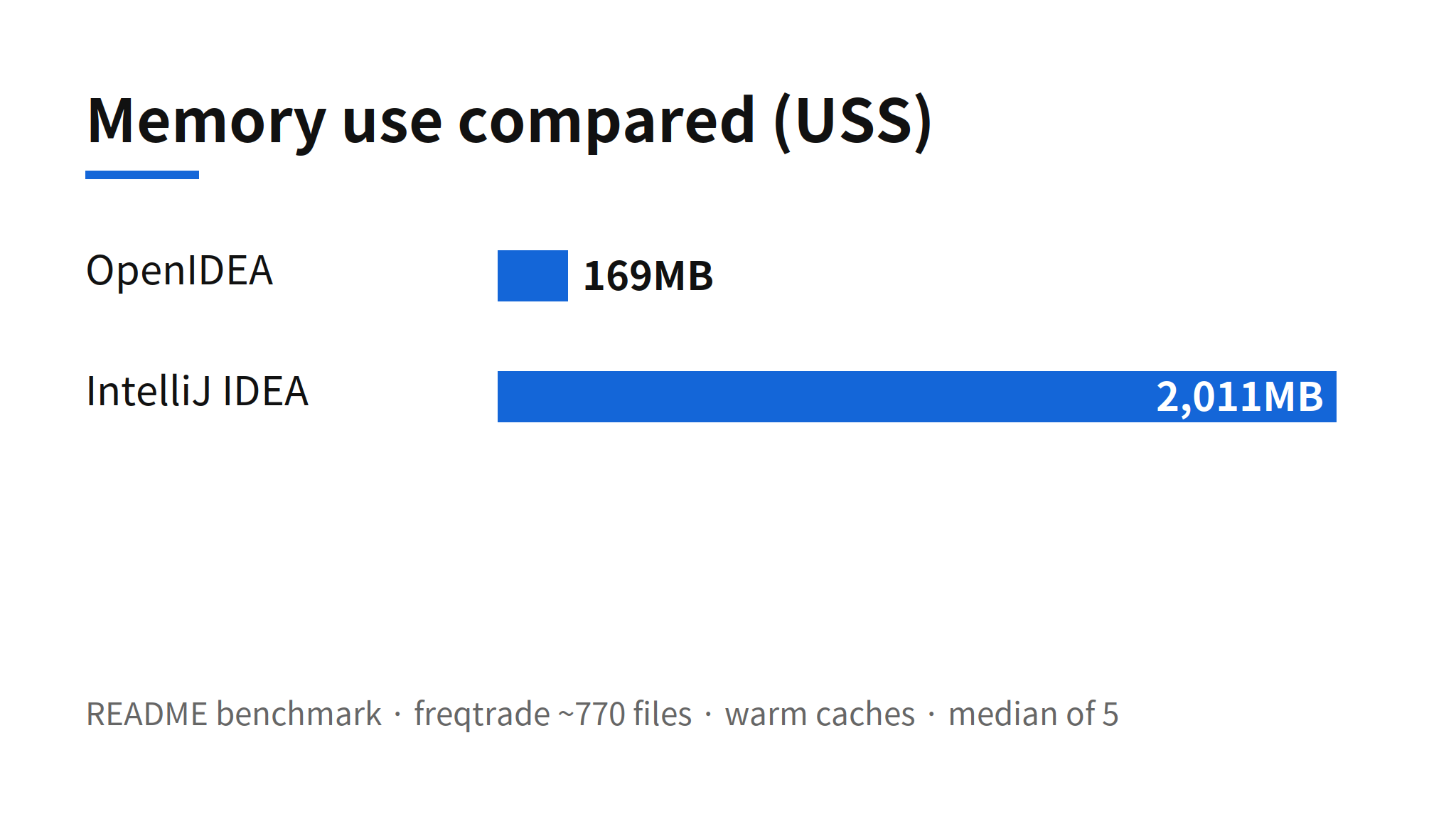
Memory is the widest gap, at roughly one twelfth of IDEA's footprint, and CPU time until ready differs by a factor of about twenty. Read in context, though, the numbers describe one machine and one project: Windows 11 on a 32-core AMD system with 62 GB of RAM. A smaller laptop or a much larger monorepo could compress or widen the gap, and no independent reproduction has been published yet. The README points readers to its perf/compare tooling to run the same measurement on their own machines and projects. That is the right way to test the claim: on the workload that actually matters to the reader.
The caveat travels with the numbers. IDEA analyses Python more deeply, so the two ready states are not equivalent work. Treating 1.1 seconds and 13.2 seconds as a like-for-like race overstates what the benchmark shows.
Included Scope and Platform Builds
The stated scope goes well beyond a text editor. The README lists an editor, code insight, a debugger, Git, a terminal, and database and HTTP clients, covering 60+ languages. Builds are provided for macOS, Windows and Linux. Keeping the database and HTTP clients inside the app matters for the IDEA comparison. Those are exactly the tool windows that pull many developers toward a full IDE instead of a lightweight editor in the first place.
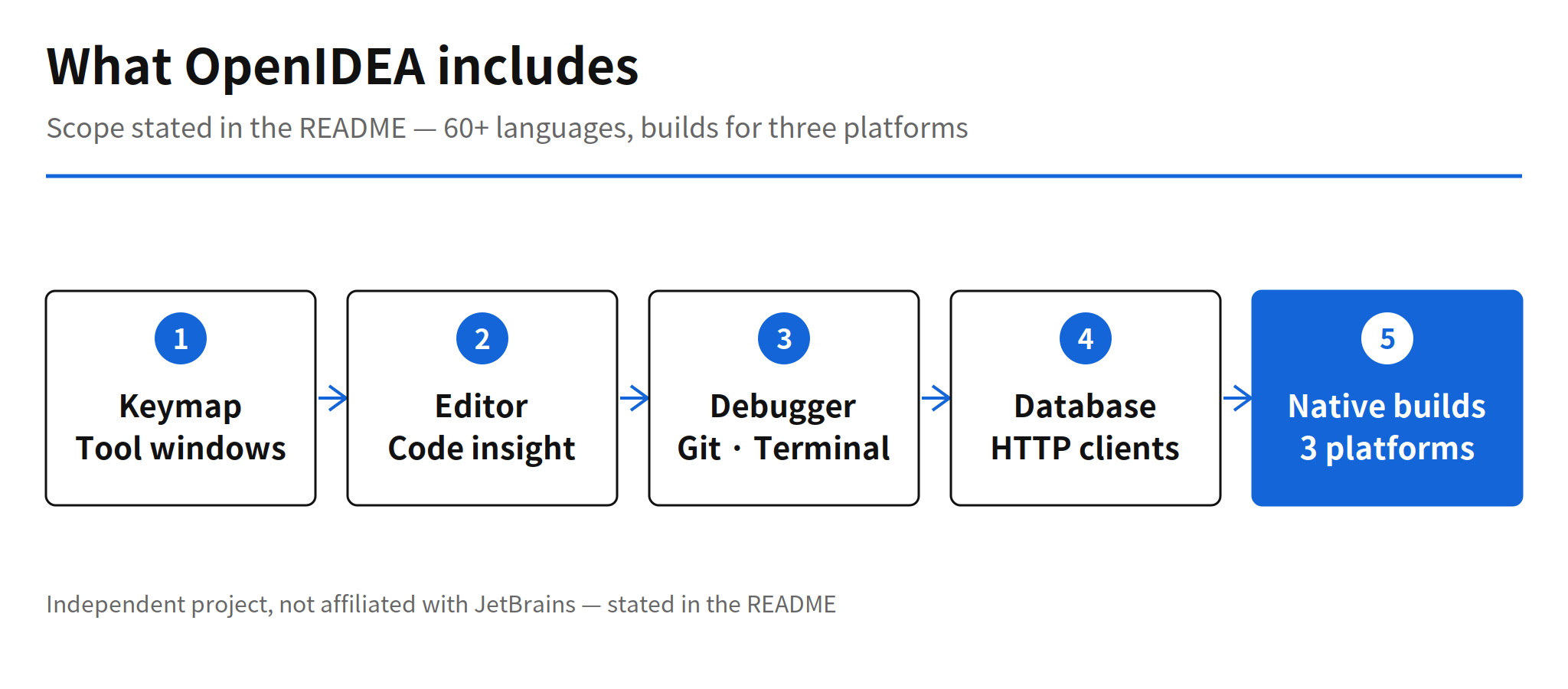
The README also states plainly that the project is not affiliated with JetBrains, and that IntelliJ IDEA is a trademark of JetBrains s.r.o. That distinction is worth keeping in any adoption discussion: the keymap and layout are an homage to a workflow, not an official port. Long-term maintenance rests with an independent open-source project.
The Rust Core and the TypeScript Language Tag
One detail invites a second look. GitHub's API classifies the repository language as TypeScript, while the README describes a Rust core. The two are not necessarily in conflict, a native shell with a substantial interface layer can easily tip the byte count toward TypeScript. Anyone evaluating the project on the strength of the Rust claim should look at the repository layout rather than the tag. The performance story depends on which parts actually run in Rust, and that split is not documented in the material published so far.
Points Still Unconfirmed
- Depth per language: how far the debugger and code insight go in each of the 60+ languages is unconfirmed.
- Plugin ecosystem compatibility: whether IntelliJ plugins work, or are planned to work, is unconfirmed.
- Benchmark reproduction: whether the README figures hold in everyday use is unconfirmed; the measurements are the author's, with the analysis-depth caveat attached.
Plugin compatibility carries the most weight in a switching decision. A workflow that leans on specific IntelliJ plugins cannot move on startup speed alone, however large the gap looks. Until that question has an answer, OpenIDEA reads as a candidate for evaluation alongside IDEA rather than a drop-in replacement for it.
Practical Judgment for a Switch
The significance of the project is not a new editing model. It is the bet that developers want the IDE they already know, minus the startup wait and the memory bill. The star growth, 3,432 in 11 days, and still climbing two days later, suggests that frustration with heavyweight IDEs is real demand. It is not just conference talk. This is also a coding tool story, not an AI feature story: OpenIDEA does not lead with AI functionality. It should not be judged as an AI coding product.
The sensible evaluation order is personal and empirical. Open the project you work in every day, check code insight and the debugger in the language you use most. Run the comparison tooling the README provides. If those hold up, the benchmark's promise becomes relevant. If they do not, the 169 MB figure stays an interesting number attached to someone else's workload.
Sources
FAQ
What is OpenIDEA?
OpenIDEA is a project from l0ng-ai that keeps the IntelliJ IDEA way of working and replaces the heavy runtime underneath it. It reimplements the IDEA-style keymap, tool windows, and Search Everywhere in a native app with a Rust core. The license is Apache-2.0, and the project is not affiliated with JetBrains.
How much memory does OpenIDEA use compared with IntelliJ IDEA?
The README benchmark puts memory at 169 MB against 2,011 MB for IntelliJ IDEA 2026.2.3, with ready time at 1.1 seconds against 13.2 seconds. Those are the author's own measurements, taken while opening a Python project of about 770 files with warm caches, as the median of 5 runs. The README itself adds the caveat that IDEA analyses Python more deeply, so the two ready states are not equivalent work, and no independent reproduction has been published yet.
Do IntelliJ plugins work in OpenIDEA?
That is unconfirmed. Whether IntelliJ plugins work, or are planned to work, has not been answered yet. Plugin compatibility carries the most weight in a switching decision, because a workflow that leans on specific IntelliJ plugins cannot move on startup speed alone.
Which platforms and languages does OpenIDEA cover?
Builds are provided for macOS, Windows, and Linux. The README lists an editor, code insight, a debugger, Git, a terminal, and database and HTTP clients, covering 60+ languages. How far the debugger and code insight go in each of the 60+ languages is unconfirmed.