Perplexity Orchestrator API: 85+ Models, One Bill, Failover
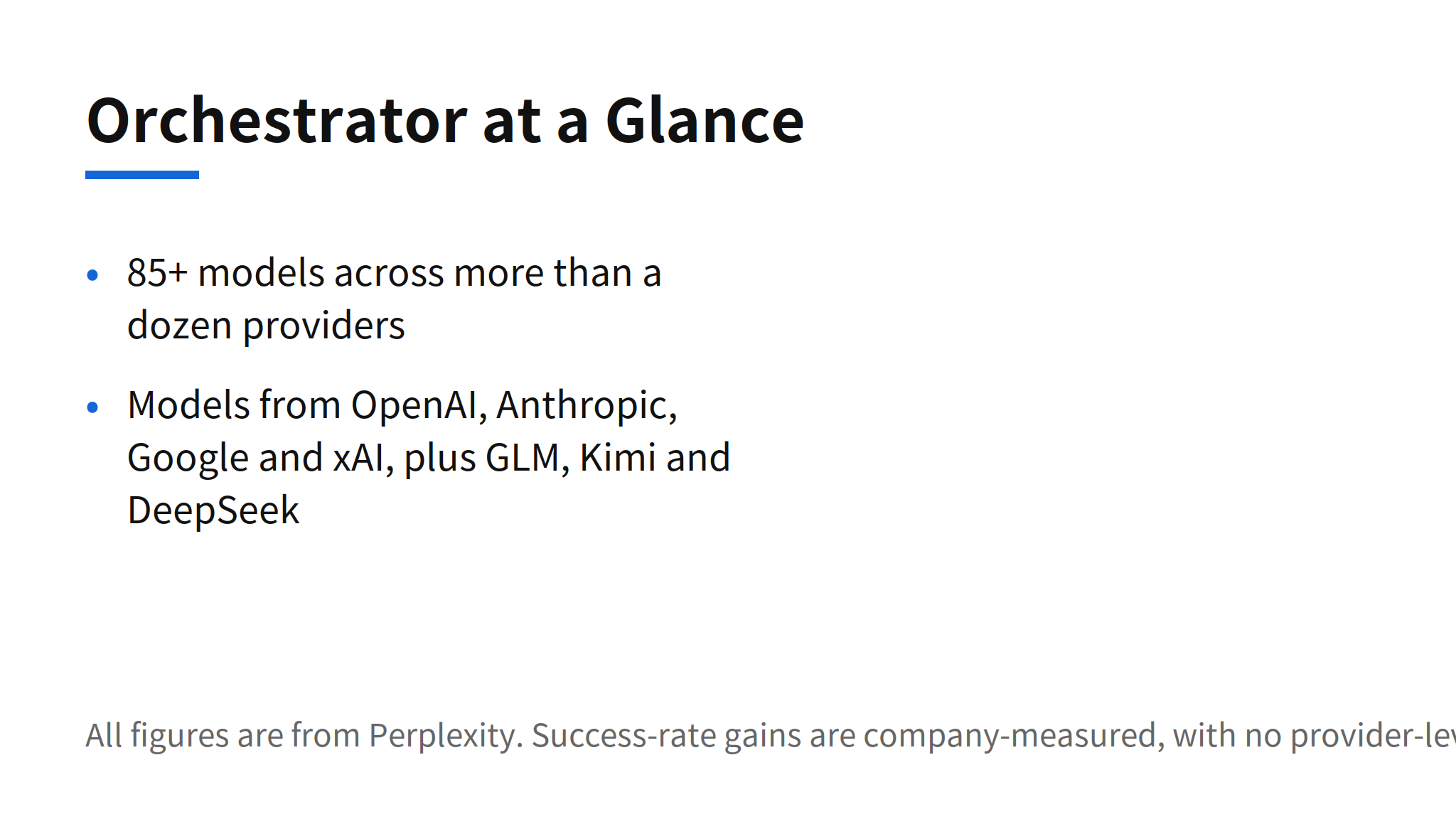
Perplexity launched the Orchestrator API on November 17, 2026, opening the model orchestration layer behind its own products to developers and teams. One API covers models from OpenAI, Anthropic, Google and xAI, plus open-weight models such as GLM, Kimi and DeepSeek, served by Perplexity itself or through inference partners. The practical pitch is operational, not a new model: simple, high-volume work can run on lower-cost models, demanding work can reserve more powerful models, and Perplexity handles provider routing and failover between them.
The scale claim behind the pitch is specific. Perplexity says its model layer routes hundreds of millions of requests across 85+ models and more than a dozen providers every day. Orchestrator is that production layer exposed as a product, which matters for how the reliability claims should be read. This is not a routing library launched from a benchmark. It is infrastructure the company already runs for its own search product, now sold to teams that face the same multi-model sprawl.
One API, Three Familiar Request Formats
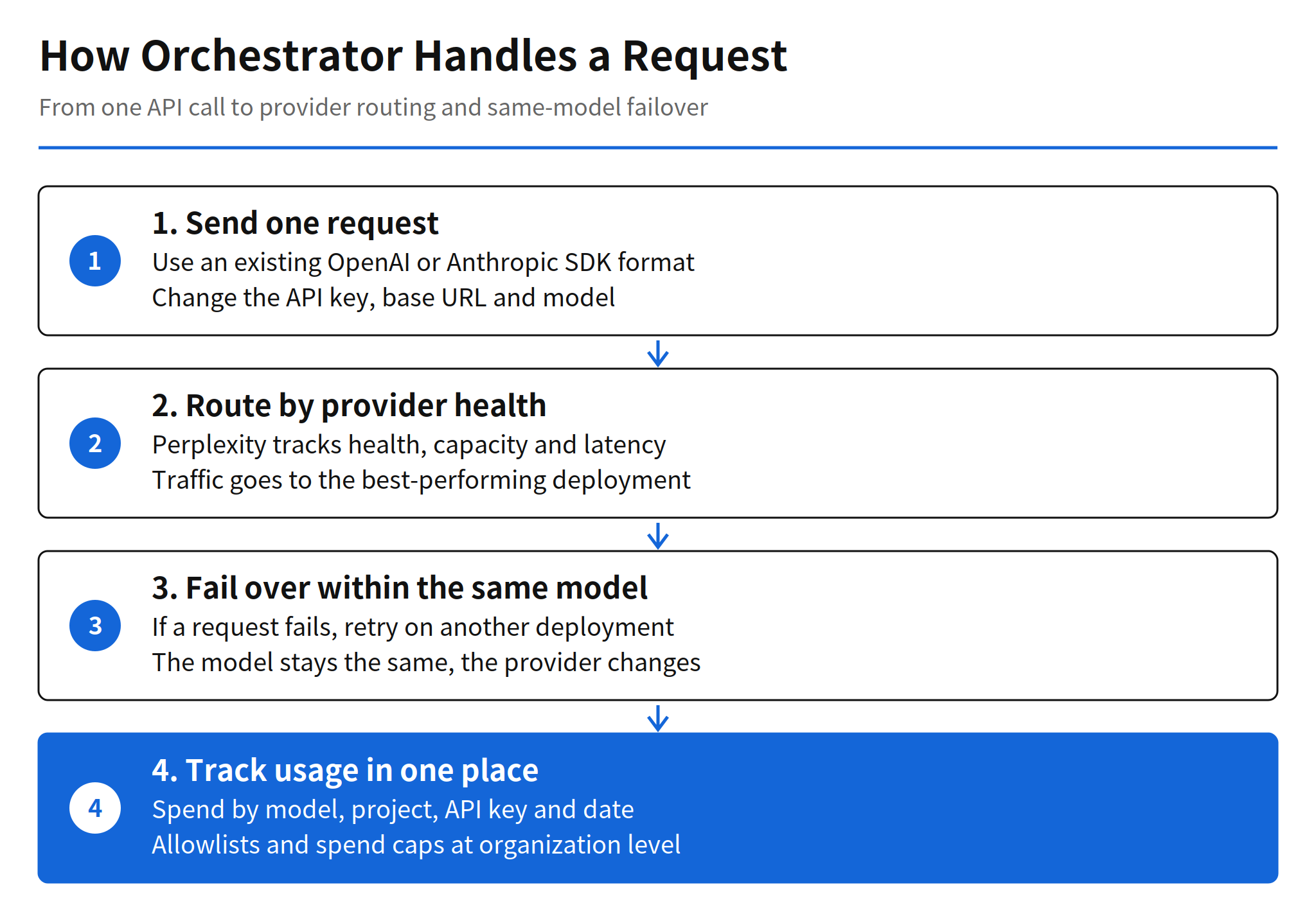
Orchestrator supports the OpenAI Chat Completions, OpenAI Responses and Anthropic Messages formats, so teams can keep using familiar SDKs. Perplexity says that for most teams, getting started involves updating the API key and base URL and selecting an available model. That low switching cost is the point. When adopting a new model becomes a configuration change instead of a new vendor relationship, the cost of trying the next release drops, and the reason to stay locked to one provider weakens.
The context Perplexity gives is the release pace itself. Labs such as Anthropic and OpenAI shipped more than a dozen new models this year, and more than 100 open-weight models shipped in the same period. Each option is useful, but each direct integration also brings its own account, contract and operational surface. Orchestrator positions itself in that gap, between model choice and model operations.
Unified Billing With No Additional Platform Fee
Billing is consolidated under one vendor and one bill, and Perplexity states there is no additional platform fee on top of credits. Teams can change their model mix without negotiating a separate commitment with each provider, which addresses a real procurement problem: an annual commitment based on a model mix can be outdated within weeks when release cycles are this fast.
Control features come through the API Console. Usage reporting breaks spend down by model, project, API key and date. Separate API keys track usage by project or team. Admin controls include organization model allowlists, user restrictions, spend caps and capacity requests. Those controls are what make a single bill governable inside a larger organization, because one invoice without per-project breakdown would trade a procurement problem for an internal accounting problem.
Same-Model Failover Across Providers
The reliability mechanism is failover within the same model. Orchestrator tracks the health, capacity and latency of each provider, distributes traffic across the best performing ones, and, if a request fails, can retry it on another deployment of the same model. Teams do not have to build or maintain that failover logic themselves. Perplexity frames the stakes in success-rate terms: for teams running millions of requests a day, the difference between 99.0% and 99.99% success affects thousands of responses.
The supporting evidence needs a clear label. Perplexity says that in one month of production traffic, Claude and GPT requests through Orchestrator had higher success rates than any individual provider it measured, with less daily variation during provider incidents. That is a company measurement. The launch post publishes no provider-level numbers, no exact success rates and no measurement methodology, so the claim is a reason to test Orchestrator on your own workload, not a verified result to plan around. Teams evaluating it should measure success rate and latency on their own traffic before migrating production work.
Routes and Auto Effort in Preview
Two features are in preview. Routes let teams describe in plain language which requests each model should handle and set a default model, starting from built-in Lower cost, Balanced or Higher quality profiles, or a custom profile. If no description or goal is provided, the default model serves the request. Auto effort adjusts how much reasoning a supported model uses on its next turn according to a policy the developer defines, so an agent can spend more effort recovering from a tool error without switching models.
Both previews point at the same direction: routing decisions moving from code into policy. That is attractive, and it is also where the risk sits. A plain-language routing rule is only as good as its evaluation, and Perplexity itself published a separate post on how it built and evaluated Routes and why model routing is hard to get right. Until Routes and Auto effort leave preview, with no general availability date announced, they should be treated as experiments to evaluate, not as the foundation of a production routing strategy.
Limits and Unconfirmed Points
- Success rates are company measured: Perplexity published no specific figures or provider comparisons for its claim that Orchestrator beat every individual provider measured.
- Per-model pricing is not in the launch post: the full model catalog and prices must be checked in the official documentation. Only the absence of an additional platform fee is stated in the post.
- Routes and Auto effort are preview features: no general availability schedule has been announced.
- Volume terms are by contact: teams with large or committed workloads are directed to email Perplexity for volume pricing and capacity, so those terms are not public.
FAQ
What is the Perplexity Orchestrator API?
Orchestrator is an API Perplexity launched on November 17, 2026. It gives developers access to more than 85 models from more than a dozen providers through one API, with unified billing and provider routing handled by Perplexity.
How does Orchestrator failover work?
Perplexity tracks the health, capacity and latency of each provider and distributes traffic across the best performing ones. If a request fails, Orchestrator can retry it on another deployment of the same model, so the model stays the same while the provider changes.
What does Orchestrator cost on top of model usage?
Perplexity says there is no additional platform fee on top of credits. Model prices themselves are listed in the official model catalog, not in the launch post, so per model pricing needs to be checked in the documentation.
Which request formats does Orchestrator support?
Orchestrator supports three formats: OpenAI Chat Completions, OpenAI Responses and Anthropic Messages. For most teams, getting started means updating the API key and base URL and selecting an available model.
What are Routes and Auto effort?
Routes and Auto effort are preview features. Routes let teams describe in plain language which requests each model should handle, starting from Lower cost, Balanced or Higher quality profiles. Auto effort adjusts how much reasoning a supported model uses on its next turn according to a developer defined policy.
Related Reading
- Perplexity Teammates Release: Persistent Agents, Pricing, the earlier Perplexity agent release on this blog
- Hugging Face OpenRouter Routing, another approach to routing requests across model providers