Anthropic S-1/A: $16.96B Revenue and the RSI Warning
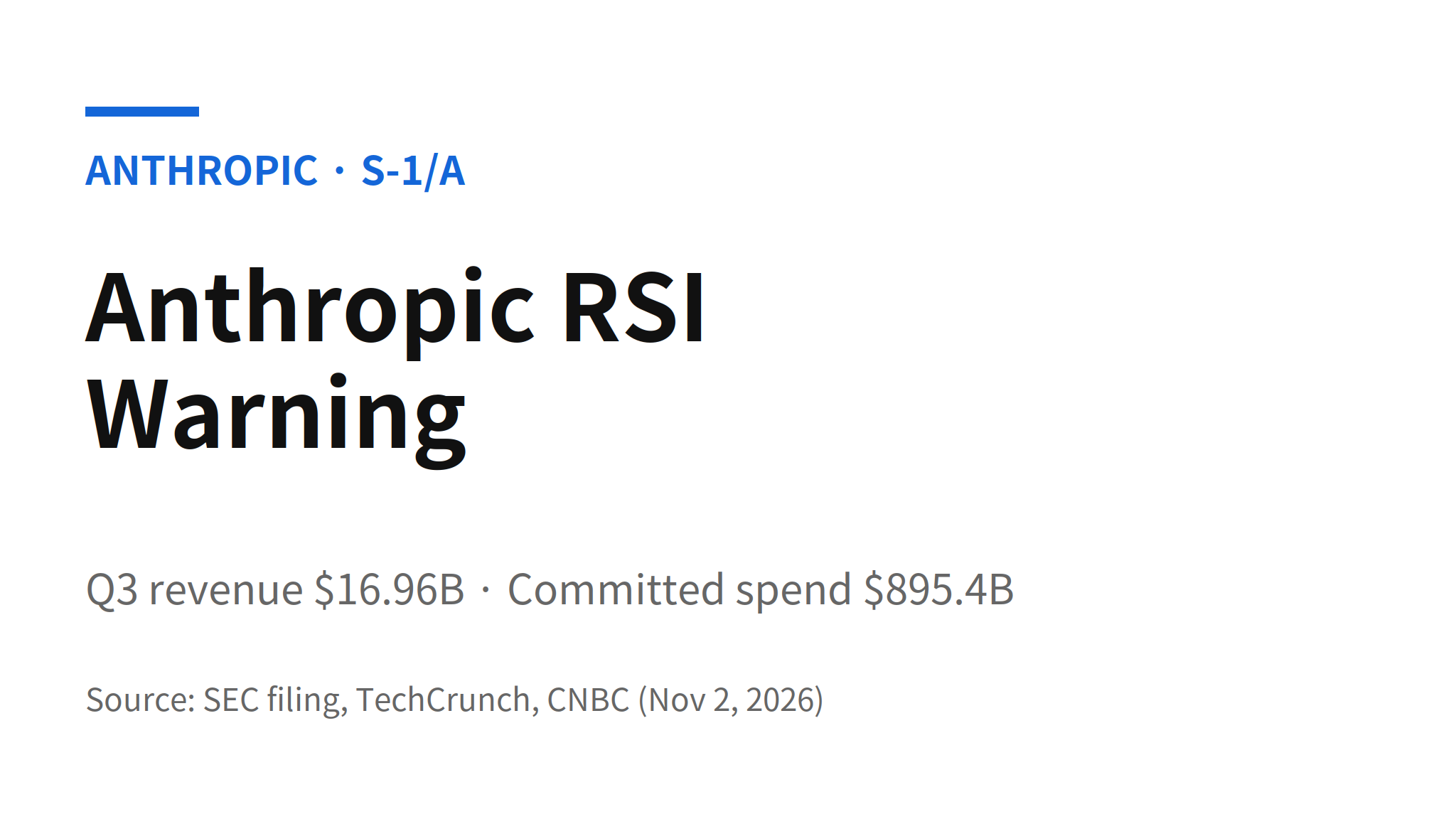
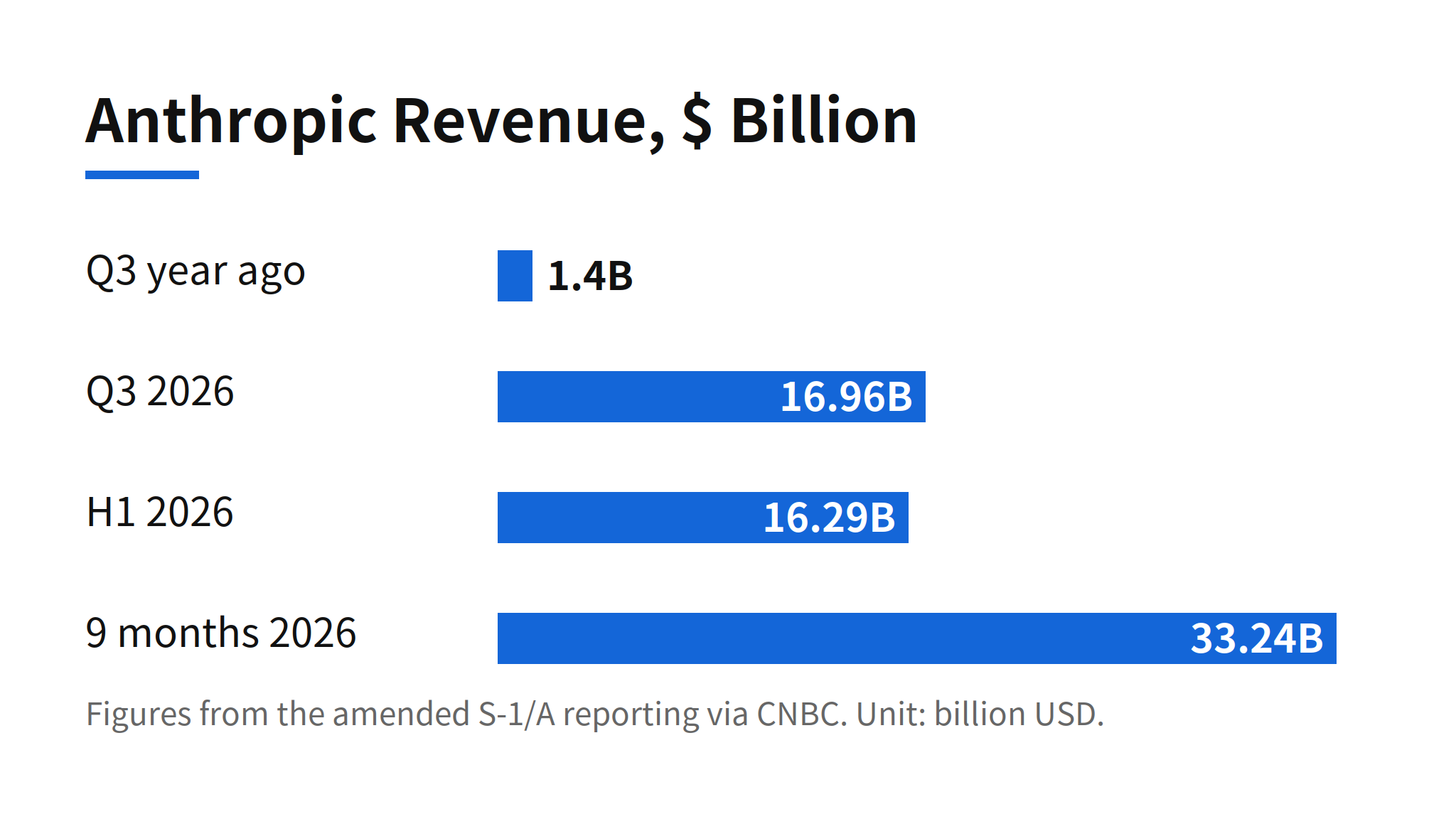
Anthropic filed an amended Form S-1/A with the US Securities and Exchange Commission on November 2, 2026. The amendment adds third-quarter results to the first S-1, which was published the previous week and covered only the first half of the year. Third-quarter revenue came in at $16.96 billion, up from $1.4 billion in the same quarter a year earlier. The more consequential change, though, sits in the risk factors. Based on internal estimates and its expectations for future models, the company now says it may imminently meet the threshold its Responsible Scaling Policy defines as dramatically accelerated progress attributable to AI.
That threshold is the filing's term for the onset of recursive self-improvement, the point where AI systems start driving AI progress itself at a sharply faster pace. Anthropic also states that no current model is designated as crossing the threshold, and that evaluation of the supporting data is still ongoing. The wording therefore does two things at once. It tells prospective investors that the company's own development speed may soon pass a line the company itself drew, and it stops short of saying that line has already been crossed.
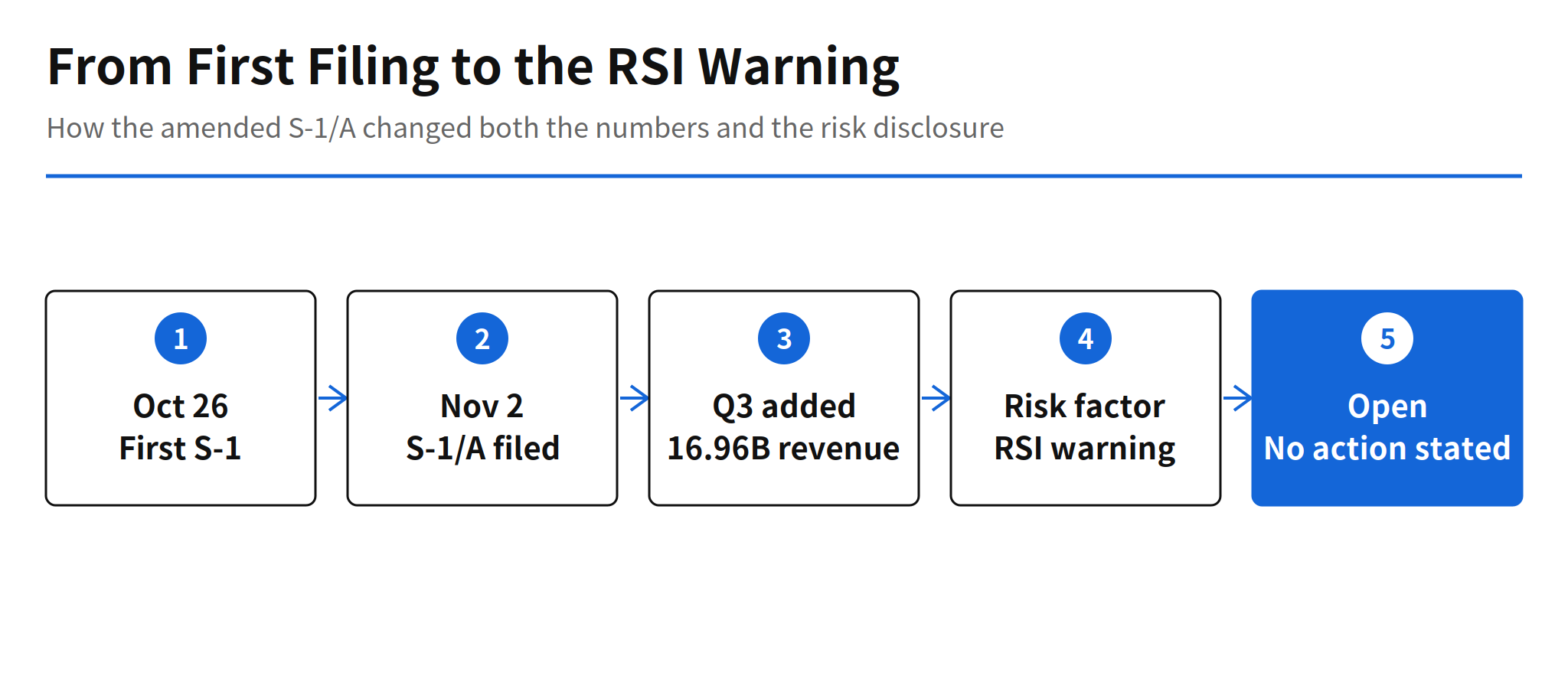
Third-Quarter Numbers in the Amended Filing
Revenue for the first nine months of the year reached $33.24 billion, an increase of about 1,200% from the same period a year earlier. The third quarter alone, at $16.96 billion, slightly exceeds the entire first-half figure of $16.29 billion reported in the original filing. Growth at that slope explains why the amendment was worth filing at all. A prospectus built on first-half numbers would have understated the current run rate by roughly half within a week of publication.
The loss figures moved just as fast. The third-quarter net loss was $23.29 billion, and the nine-month net loss reached $104 billion. Anthropic attributes most of the loss to fair value changes in convertible notes and derivative liabilities rather than to operating spend. That distinction matters for reading the filing. The headline loss is largely an accounting effect of instruments whose value rises with the company's own valuation, while the cash reality of the business is better tracked through revenue and the commitments discussed below.
Committed Spend and the Cost of Compute
Purchase and lease commitments total about $895.4 billion. The filing states that most of this committed spend relates to compute and infrastructure. About $69.8 billion of the total is scheduled for the 12 months after September 30, 2026, so the near-term portion alone is roughly four times third-quarter revenue. Compute and infrastructure costs rose by $14.4 billion over the nine-month period, an increase of 329%.
Read together, the revenue and commitment figures describe a company converting investor capital into compute at a pace that has to be justified by continued model demand. The commitments are not optional spending that can be trimmed quarter by quarter. They are contracted capacity, taken on in advance of the revenue it is meant to serve. If model demand keeps growing at anything close to the current rate, the capacity reads as foresight. If demand flattens, the same contracts become the central financial risk in the prospectus, larger in practical terms than the accounting losses above.
The RSI Risk Factor Wording
The new risk factor language is specific in a way marketing copy rarely is. The filing says Anthropic may imminently meet the Responsible Scaling Policy threshold for dramatically accelerated progress attributable to AI, based on internal estimates and expectations about future models. It adds a second, quieter admission. In the past, large accelerations in development speed were not recognized at the time they happened, and the company may likewise recognize a future acceleration only in hindsight.
The filing also states a position on the end state of that acceleration. Anthropic says it does not believe Claude can be used safely to design and build successor frontier models in a fully automated way, without meaningful human oversight. That sentence is doing practical work in the document. It bounds the RSI warning: the company is disclosing proximity to a threshold, while also telling investors and regulators that fully automated successor development is not a path it considers safe.
The weight of this disclosure comes from where it appears. A claim about approaching recursive self-improvement reads differently in a securities filing, where statements carry legal exposure, than it would in a product announcement or a keynote.
Internal Claude Use as Supporting Evidence
Other figures in the filing show why the company might write that warning now. Anthropic states that in September 2026, Claude wrote more than 90% of contributions to its internal codebase. The value of internal Claude use, priced at list rates, first exceeded monthly employee costs in April 2026, and that value grew more than 250 times between January and September. Those numbers do not prove that a threshold is near. They do show an organization where model output has already become the majority input to its own development process, which is the practical substrate the RSI discussion is about.
For engineering teams outside Anthropic, the same figures point at the nearer bottleneck. When a model writes most of the code, verification becomes the scarce resource: evaluation coverage, review capacity, and safety checks that run at the speed of generation. The filing's own numbers make that concrete. Generation capacity at Anthropic grew by orders of magnitude within a single year, and no evaluation process described anywhere in the document claims a matching growth rate.
Open Questions in the Filing
- Measurement basis: which indicators would confirm dramatically accelerated progress is not specified in the filing, and the judgment rests with the company itself.
- Follow-up action: the filing does not state whether confirming the threshold would lead to a development pause or a slower release pace.
- Offering terms: the amended filing still contains no IPO price range and no listing schedule, according to CNBC.
The disclosure also supports a second reading, and TechCrunch noted this duality directly. A risk factor that warns about approaching recursive self-improvement also signals technical strength to the market the filing is addressed to. Both readings can be true at the same time. Securities filings are written to disclose risk and to sell an offering, and a capability warning serves each purpose with the same sentence. Treating the RSI passage as pure caution or pure promotion misses how the document is built.
Practical Meaning for Evaluation and Safety Teams
The operational question raised by the filing is not whether recursive self-improvement arrives on a particular date. It is whether evaluation and safety review cycles can keep pace with release cycles that are already compressing. Anthropic's internal usage data shows code production shifting to models within months, not years. A frontier lab stating in a legal filing that it may recognize its own acceleration only after the fact is, in effect, telling every downstream team that their checkpoints cannot assume advance notice.
That has a concrete implication for AX practice. Checks that depend on a human reviewing each model release before deployment do not scale against a pipeline where the model itself produces most of the next iteration's code. The teams that cope will be the ones whose evaluation is automated, continuous, and fast enough to run inside the development loop rather than after it. The filing does not prescribe that response. It simply makes the cost of the slower arrangement visible in the company's own numbers.
FAQ
What did Anthropic add in the amended S-1/A?
The amended Form S-1/A, filed with the SEC on November 2, 2026, adds third-quarter results to the first S-1, which covered only the first half of the year. It reports Q3 revenue of $16.96 billion and nine-month revenue of $33.24 billion, and it also revises the risk factor section.
What does the RSI warning in the filing actually say?
The filing says that, based on internal estimates and expectations for future models, Anthropic may imminently meet the threshold its Responsible Scaling Policy defines as dramatically accelerated progress attributable to AI. It also says no current model is designated as crossing that threshold, and that evaluation of the supporting data is still ongoing.
How large are Anthropic's compute commitments?
Purchase and lease commitments total about $895.4 billion, most of it compute and infrastructure spending according to the filing. About $69.8 billion of that total is scheduled for the 12 months after September 30, 2026. Compute and infrastructure costs rose by $14.4 billion over nine months, an increase of 329%.
Does the amended filing state an IPO price range or a listing schedule?
No. According to CNBC reporting on the filing, the amended S-1/A contains neither an offering price range nor a listing schedule. Those details remain undisclosed at this stage of the process.
Sources
- TechCrunch: Anthropic warns that it's very close to RSI capability, aka self-building AI (November 2, 2026)
- CNBC reporting via oossa: Anthropic reports $17 billion in third-quarter revenue (November 2, 2026)
- Business Standard: Anthropic's internal Claude usage value exceeds monthly employee costs (November 3, 2026)
- Original issue: ax-trend issue #3730
- Related issues: #3537, the original S-1 filing · #3547, training pause and agent access disclosures · #3549, the Hermit continuous learning and RSI framework